Sodium Hydroxide → 2,2-dichloropropionyl-L-proline
Reaction equation

[NH:1]1[CH2:8][CH2:7][CH2:6][C@H:2]1[C:3]([OH:5])=[O:4].[OH-].[Na+].[Cl:11][C:12]([Cl:17])([CH3:16])[C:13](Cl)=[O:14]>C(Cl)Cl>[Cl:11][C:12]([Cl:17])([CH3:16])[C:13]([N:1]1[CH2:8][CH2:7][CH2:6][C@H:2]1[C:3]([OH:5])=[O:4])=[O:14]Participants
Reactant 3


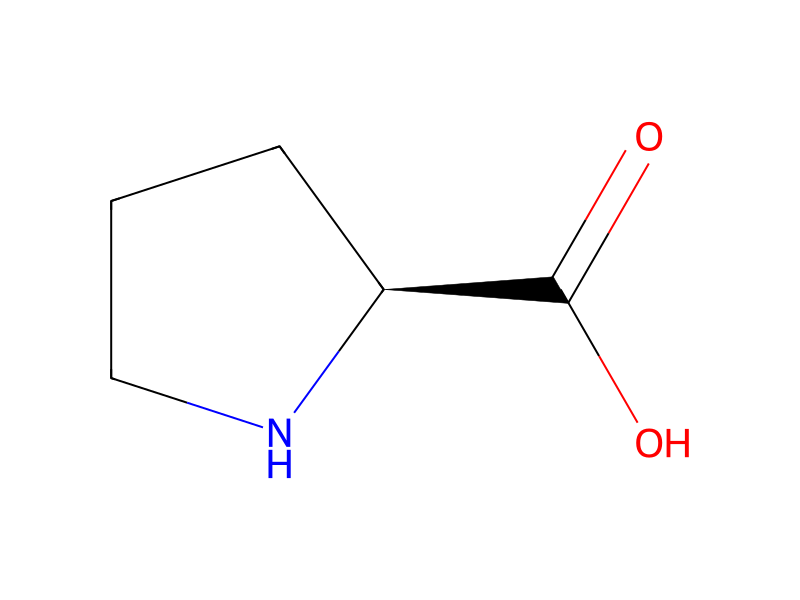
Product 1

Reagents, catalysts & solvents 1

Procedure
To a dry reaction vessel were added L-proline (115 g., 1.0 moles, 1.0 eq.), 144 mL of 6 N sodium hydroxide and 20 g. solid sodium hydroxide. The clear, colorless solution (pH=11.5) was cooled to +10° C. in an ice bath with stirring. All of the above 2,2-dichloropropionyl chloride was diluted with 50 mL methylene chloride and added to the L-proline solution over 2 hours, keeping the solution temperature below +10 ° C. and the pH at 11.5 by simultaneous addition of 290 mL of 6N sodium hydroxide to yield 2,2-dichloropropionyl-L-proline. The pH was adjusted to 3 by the addition of 216 mL of 6N hydrochloric acid. The solid which formed was collected by filtration using 300 mL of 6N hydrochloric acid as a wash to yield white crystalline 2,2-dichloropropionyl-L-proline which was dried under vacuum (30 Torr) for 18 hours to give 216 g. (90% yield based on L-proline). HPLC at 23 minutes showed ≥96% purity. The recrystallization from ethyl acetate or ethyl acetate-hexane removes 0.5 mole of water but does not significantly improve purity. m.p. 61°-62° C.
Workup
- customTo a dry reaction vessel
- customthe solution temperature below +10 ° C.
Sources & evidence
- ORD record
- ord-6132a79a31404d1ab629fc5f6ece9123
- Source dataset
- uspto-grants-1995_06
- Patent number
- US05424454
Reaction notes
Loading…