Ethylene Glycol → 2-Hydroxyethyl ethyl(2-hydroxyethyl)phosphinate
Reaction equation
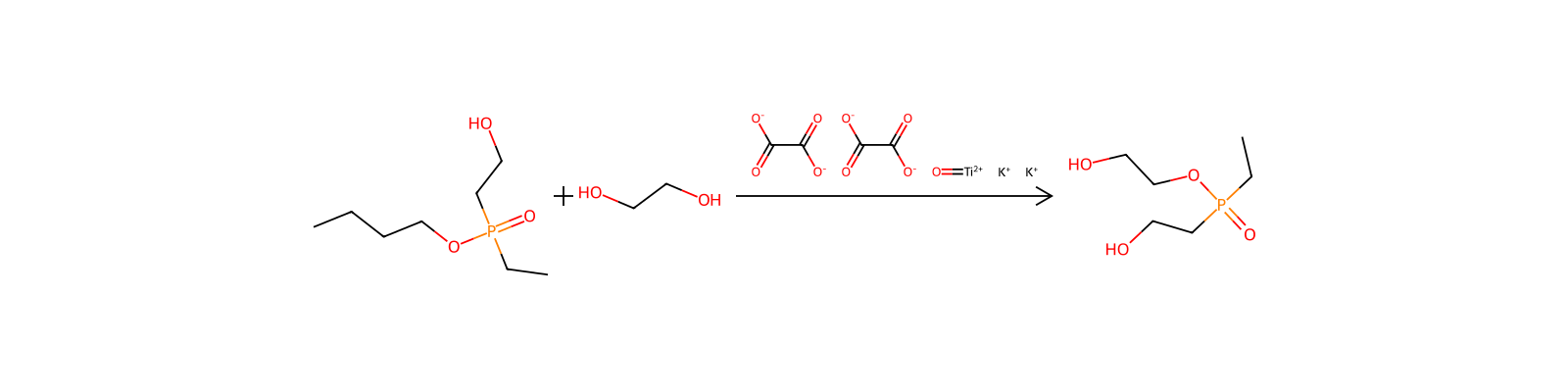
[CH2:1]([P:3]([CH2:10][CH2:11][OH:12])(=[O:9])[O:4][CH2:5][CH2:6]CC)[CH3:2].C(O)C[OH:15]>C([O-])(C([O-])=O)=O.C([O-])(C([O-])=O)=O.O=[Ti+2].[K+].[K+]>[CH2:1]([P:3]([CH2:10][CH2:11][OH:12])(=[O:9])[O:4][CH2:5][CH2:6][OH:15])[CH3:2]Participants
4
Reactant 2


Product 1

Reagents, catalysts & solvents 1

Conditions
- Temperature
- 200 °C
Procedure
To 388 g (2 mol) of butyl ethyl(2-hydroxyethyl)phosphinate (produced as in Example 12) are added 155 g (2.5 mol) of ethylene glycol and 0.4 g of potassium titanyloxalate, followed by stirring at 200° C. for 2 h. Volatiles are distilled off by gradual evacuation to leave 315 g (96% of theory) of 2-hydroxyethyl ethyl(2-hydroxyethyl)phosphinate.
Workup
- distillationVolatiles are distilled off by gradual evacuation
Sources & evidence
- ORD record
- ord-9da27bdaeebd4e668adf5aa149321310
- Source dataset
- uspto-grants-2015_06
- Patent number
- US09068119B2
Reaction notes
Loading…