Participants
| Role | Name | HCID | Charge |
|---|
| Reactant | Hydrogen Peroxide | HCID 784 | — |
| Reactant | 2,4,6-Trimethylbenzoyl chloride | HCID 97038 | — |
| Reactant | (2-Methylpropyl)(phenyl)phosphane | HCID 16703377 | — |
| Reactant | Butyllithium | HCID 178418339 | — |
| Solvent | Tetrahydrofuran | HCID 8028 | — |
| Product | HCID 18513614 | HCID 18513614 | 62% |
Reaction Steps
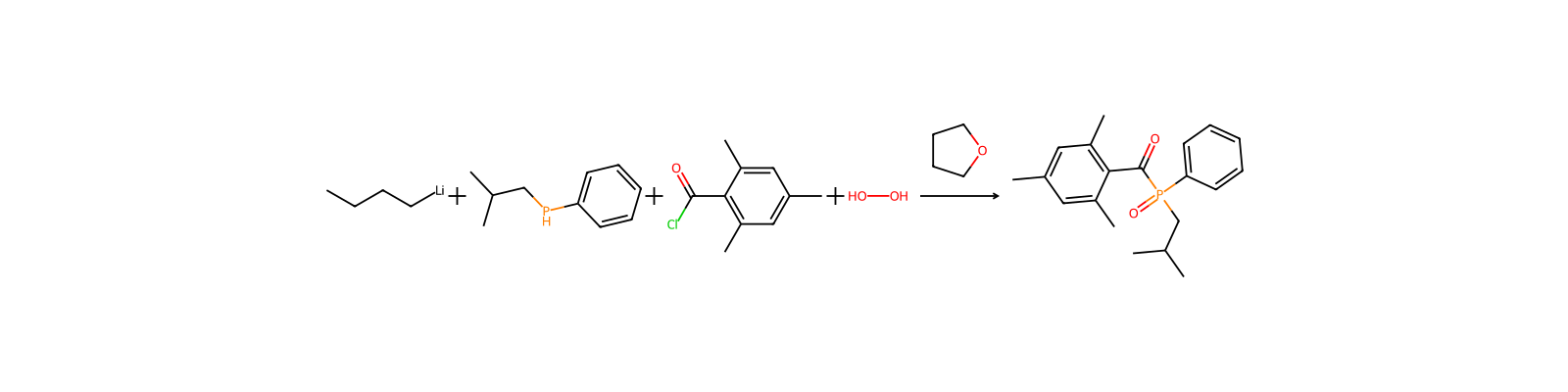
At −20° C., 40 ml (0.064 mol) of butyllithium 1.6 M are slowly added dropwise to 9.5 g (0.058 mol) of isobutylphenylphosphine in 100 ml of tetrahydrofuran (THF). At the same temperature, 11.7 g (0.064 mol) of 2,4,6-trimethylbenzoyl chloride are then added dropwise. After the mixture has been allowed to warm to room temperature, the orange reaction suspension is concentrated using a rotary evaporator (Rotavap). The residue is taken up in 150 ml of toluene, and is treated with 13.1 g (0.116 mol) of hydrogen peroxide 30%. After the mixture has been stirred for 2 hours between 20-30° C., the reaction is complete. The reaction emulsion is poured onto water and washed with aqueous saturated sodium hydrogencarbonate solution, then dried over magnesium sulfate and filtered. The filtrate is concentrated using the Rotavap. The residue is purified over silica gel and dried under a high vacuum. 11.8 g of the title compound are obtained as a yellow viscous oil.
Provenance & Evidence
| DOI | 10.6084/m9.figshare.5104873.v1 |
|---|
| Patent number | US06399805B2 |
|---|
| Source dataset | uspto-grants-2002_06 |
|---|
| ORD ID | ord-2e41a51802fe498aa9f6823c0f344121 |
|---|
| Source note | uspto-grants-2002_06 |
|---|