Hydrochloric Acid → Ethyl 3-cyclopropyl-2,2-difluoropropanoate
Reaction equation

F[C:2](F)(F)C(O)=O.ICI.[F:11][C:12]([F:21])([CH2:18][CH:19]=[CH2:20])[C:13]([O:15][CH2:16][CH3:17])=[O:14].Cl>ClCCl.[Cu].[Zn]>[CH:19]1([CH2:18][C:12]([F:21])([F:11])[C:13]([O:15][CH2:16][CH3:17])=[O:14])[CH2:2][CH2:20]1Participants
Reactant 4


Product 1

Reagents, catalysts & solvents 2

Conditions
- Temperature
- 2.5 °C
Procedure
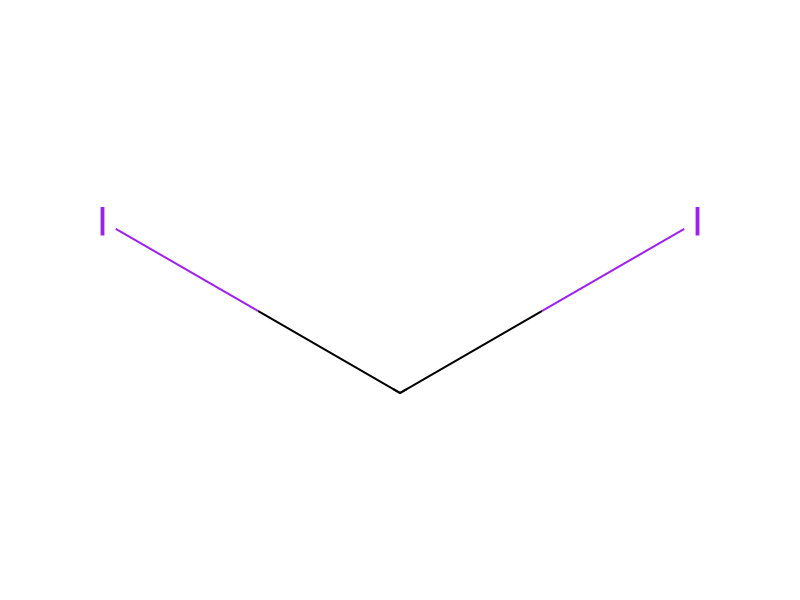
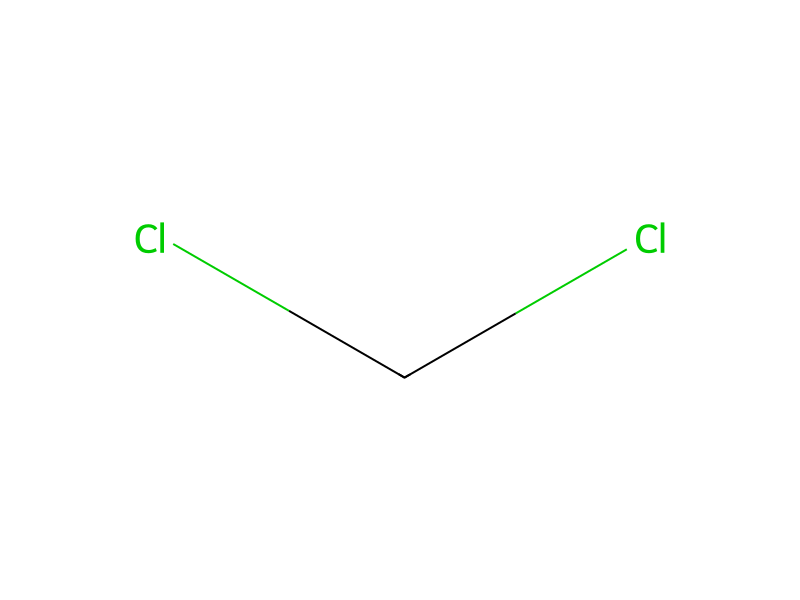
Zinc-copper (Zn—Cu) couple (1.6 Kg, 800 mol %) and dichloromethane (7.5 L) was charged into a dry 20.0 L, 4-neck round bottomed flask, fitted with an over head stirrer, a thermo socket and a condenser under a nitrogen atmosphere. Trifluoroacetic acid (235 mL, 100 mol %) was added to the above Zn—Cu couple at ambient temperature via addition funnel over 30 minutes. Diiodomethane (860 mL; 2.86 Kg; 10.7 mol; 352 mol %) was added to above the Zn—Cu couple at ambient temperature via addition funnel over 1.5 hours. The reaction temperature was raised to reflux and then ethyl 2,2-difluoropent-4-enoate (500 g; 3.05 mol) in dichloromethane (500 mL) was added slowly via addition funnel over 30 minutes at reflux. The reaction temperature was maintained for 40-60 hours at reflux. Progress of the reaction was monitored by GC analysis which showed about 93% conversion to product based on relative area % of the peaks corresponding to product and starting material. The reaction mass was cooled to 0-5° C. and 5% dilute hydrochloric acid (500 mL) was added then the solution was filtered and washed with dichloromethane (1500 mL). The filtrate was washed with a solution of 5% aqueous hydrochloric acid (500 mL), water (1000 mL) followed by a solution of brine (1000 mL). The organic layer was concentrated under vacuum at 35° C./260-360 mm Hg to provide crude ethyl 3-cyclopropyl-2,2-difluoropropanoate (740 g), which was 79% pure by GC analysis. The crude product was then subjected to an oxidative work-up as described below to remove residual starting material (5% by area as determined by GC analysis).
Workup
- customfitted with an over head stirrer
- temperatureThe reaction temperature was raised
- temperatureto reflux
- temperatureat reflux
- temperatureThe reaction temperature was maintained for 40-60 hours
- temperatureat reflux
- filtrationthe solution was filtered
- washwashed with dichloromethane (1500 mL)
- washThe filtrate was washed with a solution of 5% aqueous hydrochloric acid (500 mL), water (1000 mL)
- concentrationThe organic layer was concentrated under vacuum at 35° C./260-360 mm Hg
Sources & evidence
- ORD record
- ord-62f99724f4a74399a094cd9a33e93216
- Source dataset
- uspto-grants-2012_12
- Patent number
- US08324417B2
Reaction notes
Loading…