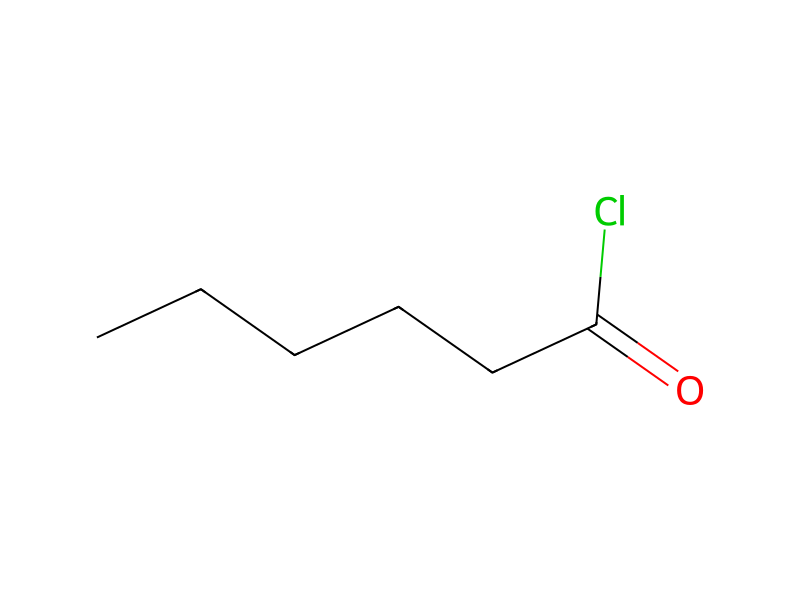
Hexanoyl chloride → HCID 10130904, compound
Reaction equation

[Cl-].[Al+3].[Cl-].[Cl-].C[O:6][C:7]1[C:8](=[CH:12][CH:13]=[CH:14][CH:15]=1)[C:9]([O-:11])=[O:10].[C:16](Cl)(=[O:22])[CH2:17][CH2:18][CH2:19][CH2:20][CH3:21]>C(=S)=S>[C:16]([C:13]1[CH:12]=[C:8]([C:9]([OH:11])=[O:10])[C:7]([OH:6])=[CH:15][CH:14]=1)(=[O:22])[CH2:17][CH2:18][CH2:19][CH2:20][CH3:21]Participants
Reactant 3


Product 1

Reagents, catalysts & solvents 1

Conditions
- Temperature
- 2.5 °C
Procedure
A one-liter three-neck flask is fitted with a 250 ml dropping funnel, a mechanical overhead stirrer, and a condenser with a drying tube. A mixture of anhydrous aluminum chloride (120 g., 0.9 moles) and carbon disulfide (250 ml) is placed in the flask and cooled to 0-5 degrees C. with an ice bath. A solution of methylsalicylate (45.6 g., 0.3 mole) and n-hexanoyl chloride (81.4 g., 0.6 mole) in carbon disulfide (50 ml) is then added through the dropping funnel over the course of three hours while maintaining the temperature of the reaction mixture below 10 degrees C. The reaction mixture is then allowed to warm to room temperature and stirring is continued for 24 hours. The mixture is then poured slowly onto cracked ice (500 g.) and the resulting slurry is stirred until the ice melts. The slurry is then extracted with four 50 ml portions of diethyl ether and the combined ether extracts are washed with water and dried over anhydrous sodium sulfate. Any remaining liquid is removed by evaporation in a vacuum. The resulting product is found to be n-hexanoyl methyl salicylate in a yield of 77% with a melting point of 48°-49° C.
Workup
- customA one-liter three-neck flask is fitted with a 250 ml
- temperaturewhile maintaining the temperature of the reaction mixture below 10 degrees C
- temperatureto warm to room temperature
- additionThe mixture is then poured slowly
- extractionThe slurry is then extracted with four 50 ml portions of diethyl ether
- washthe combined ether extracts are washed with water
- dry with materialdried over anhydrous sodium sulfate
- customAny remaining liquid is removed by evaporation in a vacuum
Sources & evidence
- ORD record
- ord-7f61601c94d74b2f8fa5eef80575e517
- Source dataset
- uspto-grants-1982_11
- Patent number
- US04358443
Reaction notes
Loading…