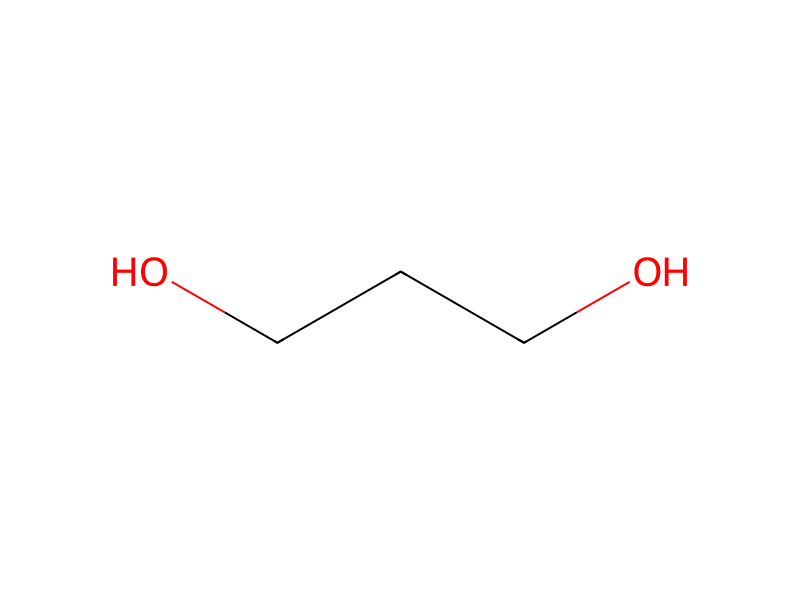
Acetonitrile, 2,2-diethoxy- → 1,3-Propanediol
Reaction equation

[CH2:1]([O:3][CH:4]([O:7][CH2:8][CH3:9])C#N)C.C[O:11][CH:12]([C:15]([CH:17](OC)[O:18]C)=O)OC>C1C=CC=CC=1.CC1C=CC(S(O)(=O)=O)=CC=1>[CH2:17]([OH:18])[CH2:15][CH2:12][OH:11].[O:3]1[CH2:1][CH2:9][CH2:8][O:7][CH2:4]1Participants
5
Reactant 2


Product 2

Reagents, catalysts & solvents 1

Procedure
The new route to Michael acceptors enabled expansion of the structural diversity of these intermediates. Diethoxymethyl Michael acceptor 1b was prepared from commercially available diethoxyacetonitrile in analogy with the synthesis of 1a. Transacetalization of diethoxyacetal 1b with 1,3-propanediol in benzene/TsOH afforded 1,3-dioxane 1c in 64% yield. On the other hand, attempted transacetalization of 1b with ethylene glycol gave an inseparable mixture consisting of 1,3-dioxolane 1d and a by-product assumed to be bis(1,3-dioxolane) C (Scheme 6). Transacetalization of diethoxyacetonitrile with ethylene glycol in the presence of TsOH also did not proceed. Therefore, we considered an alternative approach to 1d.
Sources & evidence
- ORD record
- ord-842dbdcf0dd5418d83c56ad55316b140
- Source dataset
- uspto-grants-2016_06
- Patent number
- US09365722B2
Reaction notes
Loading…