3-Chloro-4-fluoroaniline → 4-(3-Chloro-4-fluoroanilino)-7,8-dimethoxybenzo[g]quinoline-3-carbonitrile
Reaction equation

Cl[C:2]1[C:11]2[C:6](=[CH:7][C:8]3[CH:15]=[C:14]([O:16][CH3:17])[C:13]([O:18][CH3:19])=[CH:12][C:9]=3[CH:10]=2)[N:5]=[CH:4][C:3]=1[C:20]#[N:21].[Cl:22][C:23]1[CH:24]=[C:25]([CH:27]=[CH:28][C:29]=1[F:30])[NH2:26].Cl.N1C=CC=CC=1>C(OCCO)C>[Cl:22][C:23]1[CH:24]=[C:25]([CH:27]=[CH:28][C:29]=1[F:30])[NH:26][C:2]1[C:11]2[C:6](=[CH:7][C:8]3[CH:15]=[C:14]([O:16][CH3:17])[C:13]([O:18][CH3:19])=[CH:12][C:9]=3[CH:10]=2)[N:5]=[CH:4][C:3]=1[C:20]#[N:21]Participants
5
Reactant 3
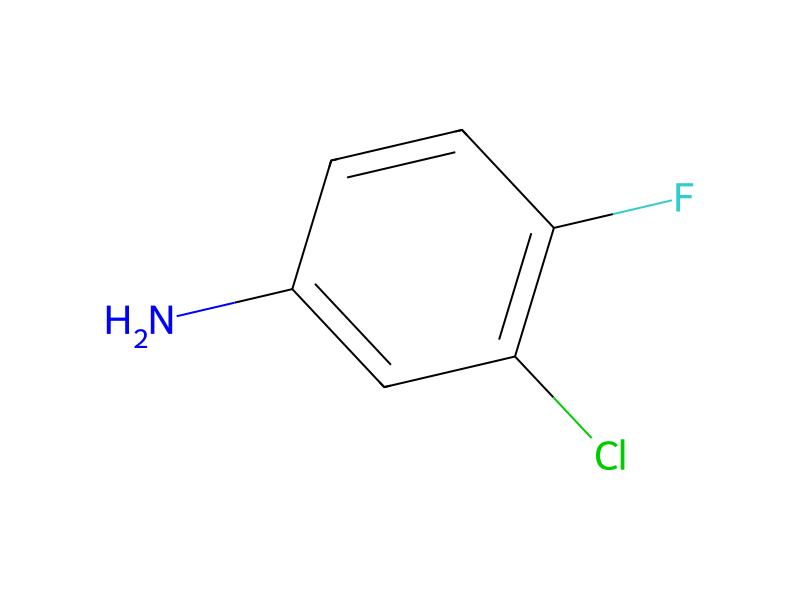


Product 1

Reagents, catalysts & solvents 1

Procedure
Following the procedure of Example 11, a mixture of 149.4 mg (0.50 mmol) of 4-chloro-7,8-dimethoxybenzo[g]quinoline-3-carbonitrile, 87.3 mg (0.60 mmol) of 3-chloro-4-fluoroaniline and 57.8 mg (0.50 mmol) of pyridine hydrochloride in 7.0 mL of 2-ethoxyethanol is heated at 100–110° C. for 1.0 hour to yield 184.4 mg (83.0%) of the product as a yellow solid, mp>280° C.
Workup
- temperatureis heated at 100–110° C. for 1.0 hour
Sources & evidence
- ORD record
- ord-be9f8329616642cd9ead0c2cae48f19d
- Source dataset
- uspto-grants-2006_09
- Patent number
- US07105531B2
Reaction notes
Loading…