Difluoro(fluorosulphonyl)acetyl fluoride → HCID 21940881, compound
Reaction equation

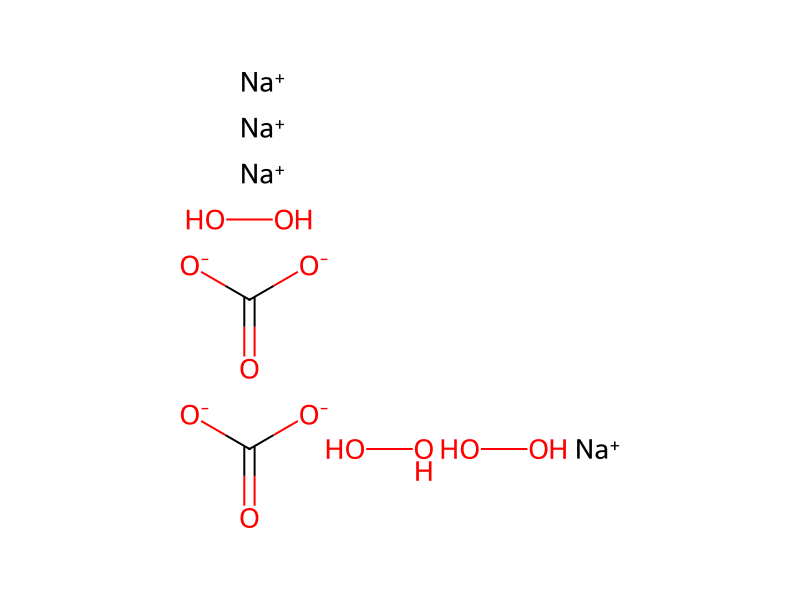
[C:1]([O-:4])([O-:3])=O.[C:5]([O-:8])([O-])=[O:6].OO.OO.OO.[Na+].[Na+].[Na+].[Na+].[F:19][S:20]([C:23](C(F)=O)([F:25])[F:24])(=[O:22])=[O:21]>C(Cl)(F)(F)C(Cl)(Cl)F>[F:25][C:23]([F:24])([S:20]([F:19])(=[O:21])=[O:22])[C:1]([O:4][O:8][C:5](=[O:6])[C:23]([F:25])([F:24])[S:20]([F:19])(=[O:22])=[O:21])=[O:3]Participants
4
Reactant 2

Product 1

Reagents, catalysts & solvents 1

Conditions
- Temperature
- 0 °C
Procedure
A round-bottom flask is charged with 50 ml of CFC-113 and 2.0 g of sodium percarbonate (13 mmoles or 19 mmoles of H2O2 equivalent). After chilling the contents of the flask to 0° C., 2.83 ml of FSO2CF2(C═O)F (25 mmoles) is added and the resulting slurry is stirred magnetically for 3 hours. The reaction mixture is filtered through a pad of Drierite® on glass wool, washing through with fresh CFC-113, an operation assumed to remove any unreacted percarbonate and any free H2O2. The filtrate, now measuring 52 ml in volume, is found to be 0.10 M in peroxide for a 42% yield based on starting FSO2CF2(C═O)F.
Workup
- filtrationThe reaction mixture is filtered through a pad of Drierite® on glass wool
- washwashing through with fresh CFC-113
- customto remove any unreacted percarbonate
Sources & evidence
- ORD record
- ord-5210efb40b7e4edcbb99630896323245
- Source dataset
- uspto-grants-2006_09
- Patent number
- US07112314B2
Reaction notes
Loading…