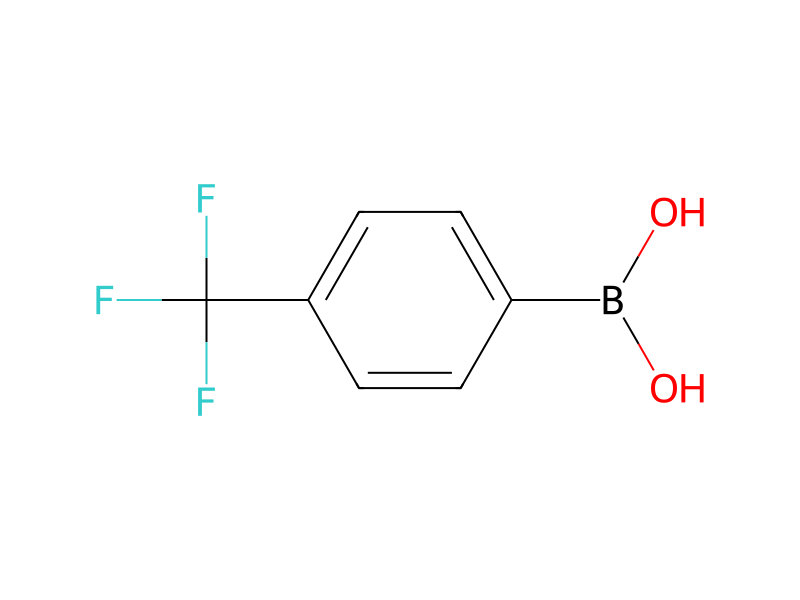
4-(Trifluoromethyl)phenylboronic acid → 5-(4-Trifluoromethyl-benzylidene)-10,11-dihydro-5H-dibenzo[a,d]cycloheptene
Reaction equation

Br[CH:2]=[C:3]1[C:9]2[CH:10]=[CH:11][CH:12]=[CH:13][C:8]=2[CH2:7][CH2:6][C:5]2[CH:14]=[CH:15][CH:16]=[CH:17][C:4]1=2.[F:18][C:19]([F:30])([F:29])[C:20]1[CH:25]=[CH:24][C:23](B(O)O)=[CH:22][CH:21]=1>>[F:18][C:19]([F:30])([F:29])[C:20]1[CH:25]=[CH:24][C:23]([CH:2]=[C:3]2[C:9]3[CH:10]=[CH:11][CH:12]=[CH:13][C:8]=3[CH2:7][CH2:6][C:5]3[CH:14]=[CH:15][CH:16]=[CH:17][C:4]2=3)=[CH:22][CH:21]=1Participants
3


Procedure
Combine 5-bromomethylene-10,11-dihydro-5H-dibenzo[a,d]cycloheptene (0.5 g, 1.75 mmol) and 4-(trifluoromethyl)phenyl boronic acid (0.33 g, 1.75 mmol using procedures essentially as described in Example 219, below. Pass through a plug of silica gel equilibrated with hexanes. Concentrate the filtrate to give the title product: MS (m/e): 350 (M+). HPLC (ISO80-10M)) t=17.32 min.
Workup
- concentrationConcentrate the filtrate
Sources & evidence
- ORD record
- ord-792015666ab545d2911c18b1173fc88f
- Source dataset
- uspto-grants-2008_08
- Patent number
- US07411072B2
Reaction notes
Loading…