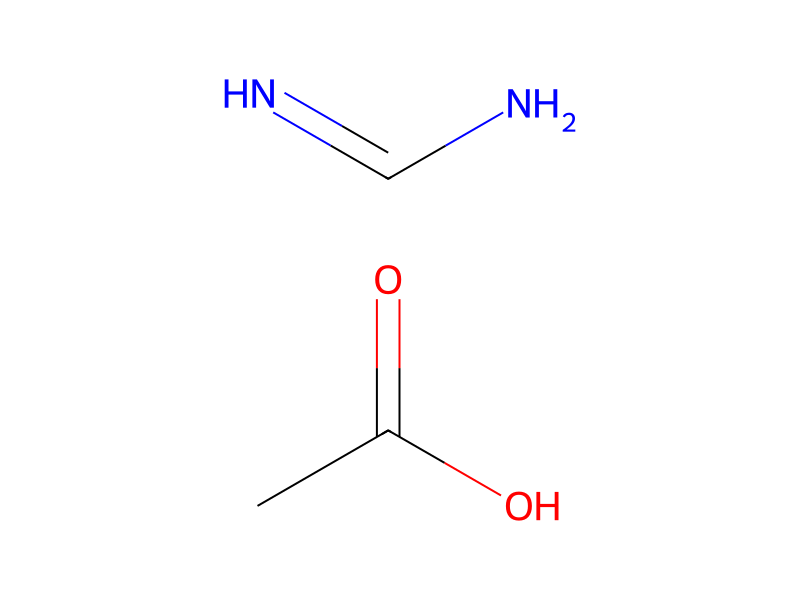
Formamidine acetate → 7-Benzyl-5,6,7,8-tetrahydropyrido[3,4-d]pyrimidin-4(4aH)-one
Reaction equation

Cl.[CH2:2]([N:9]1[CH2:14][CH2:13][CH:12]([C:15]([O:17]CC)=O)[C:11](=O)[CH2:10]1)[C:3]1[CH:8]=[CH:7][CH:6]=[CH:5][CH:4]=1.C(O)(=O)C.[CH:25]([NH2:27])=[NH:26]>>[CH2:2]([N:9]1[CH2:14][CH2:13][CH:12]2[C:11](=[N:27][CH:25]=[N:26][C:15]2=[O:17])[CH2:10]1)[C:3]1[CH:8]=[CH:7][CH:6]=[CH:5][CH:4]=1Participants


Procedure
Various N-substituted-7-(pyridin-2-yl)-5,6,7,8-tetrahydropyrido[3,4-d]pyrimidin-4-amine derivatives are prepared using a general procedure described below. Accordingly, ethyl 1-benzyl-3-oxopiperidine-4-carboxylate hydrochloride is reacted with formamidine acetate to yield 7-benzyl-5,6,7,8-tetrahydropyrido[3,4-d]pyrimidin-4(4aH)-one, which, in turn, is reacted with POCl3 to afford the 4-chloro derivative. The intermediate chloro derivative is then condensed with substituted aniline or amine to give the desired N-substituted-7-benzyl-5,6,7,8-tetrahydropyrido[3,4-d]pyrimidin-4-amine. Debenzylation using standard procedures known in the art followed by nucleophilic displacement of an appropriate 2-halo-pyridine yields the appropriate N-substituted-7-(pyridin-2-yl)-5,6,7,8-tetrahydropyrido[3,4-d]pyrimidin-4-amine. As a representative example, synthesis of N-(4-tert-butylphenyl)-7-(3-chloropyridin-2-yl)-5,6,7,8-tetrahydropyrido[3,4-d]pyrimidin-4-amine is depicted in Scheme 1.
Sources & evidence
- ORD record
- ord-55ffe00c38ec48a1af059fda92fae071
- Source dataset
- uspto-grants-2008_08
- Patent number
- US07414131B2
Reaction notes
Loading…