N-Carbethoxyphthalimide → 2-(2-(4-Bromophenyl)-5,8-dioxaspiro[3.4]octan-2-yl)isoindoline-1,3-dione
Reaction equation
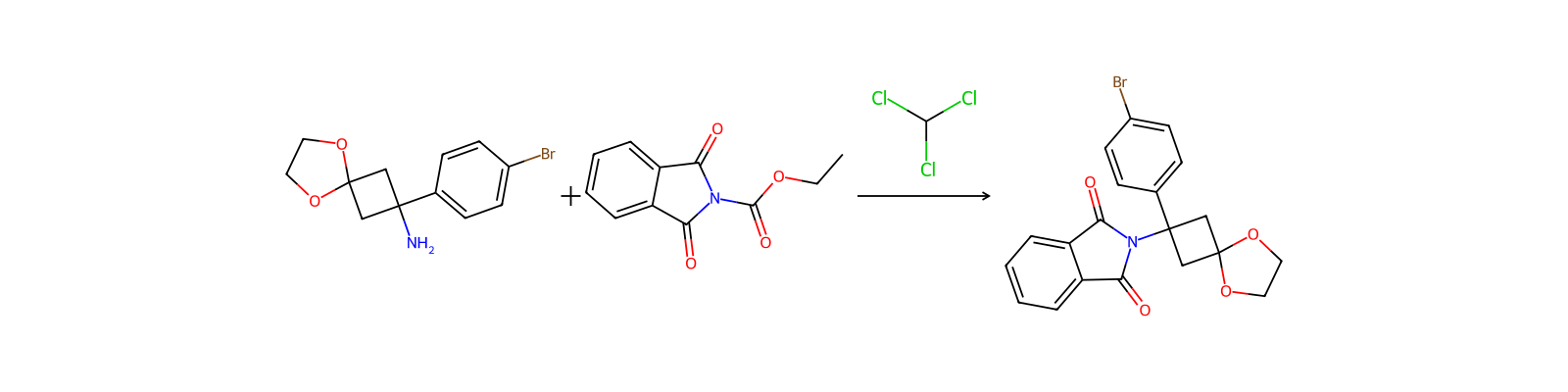
[Br:1][C:2]1[CH:7]=[CH:6][C:5]([C:8]2([NH2:16])[CH2:11][C:10]3([O:15][CH2:14][CH2:13][O:12]3)[CH2:9]2)=[CH:4][CH:3]=1.[O:17]=[C:18]1[C:26]2[C:21](=[CH:22][CH:23]=[CH:24][CH:25]=2)[C:20](=[O:27])N1C(OCC)=O>C(Cl)(Cl)Cl>[Br:1][C:2]1[CH:7]=[CH:6][C:5]([C:8]2([N:16]3[C:18](=[O:17])[C:26]4[C:21](=[CH:22][CH:23]=[CH:24][CH:25]=4)[C:20]3=[O:27])[CH2:11][C:10]3([O:12][CH2:13][CH2:14][O:15]3)[CH2:9]2)=[CH:4][CH:3]=1Participants
4



Conditions
- Temperature
- 70 °C
Procedure
A mixture of 2-(4-bromophenyl)-5,8-dioxaspiro[3.4]octan-2-amine (7-1) (2.7 g, 9.50 mmol), ethyl 1,3-dioxo-1,3-dihydro-2H-isoindole-2-carboxylate (4.2 g, 19.0 mmol), and TEA (5.3 mL, 38.0 mmol) in CHCl3 (50 mL) was stirred at 70° C. for overnight. The solvent was evaporated under reduced pressure, and to the residue was added MeOH. The resulting solid was collected by filtration to give 2-[2-(4-bromophenyl)-5,8-dioxaspiro[3.4]oct-2-yl]-1H-isoindole-1,3(2H)-dione (7-2) as a colorless solid.
Workup
- customThe solvent was evaporated under reduced pressure
- additionto the residue was added MeOH
- filtrationThe resulting solid was collected by filtration
Sources & evidence
- ORD record
- ord-a288a75db540489bb30c9030d98da4ef
- Source dataset
- uspto-grants-2012_06
- Patent number
- US08207169B2
Reaction notes
Loading…