Pyridine → 3-(2-Oxo-pyrrolidin-1-ylimino)-3-pyridin-2-yl-propionic acid ethyl ester
Reaction equation

Cl.[NH2:2][N:3]1[CH2:7][CH2:6][CH2:5][C:4]1=[O:8].[CH2:9]([O:11][C:12](=[O:22])[CH2:13][C:14](=O)[C:15]1[CH:20]=[CH:19][CH:18]=[CH:17][N:16]=1)[CH3:10].N1C=CC=CC=1>O>[CH2:9]([O:11][C:12](=[O:22])[CH2:13][C:14](=[N:2][N:3]1[CH2:7][CH2:6][CH2:5][C:4]1=[O:8])[C:15]1[CH:20]=[CH:19][CH:18]=[CH:17][N:16]=1)[CH3:10]Participants
5




Procedure
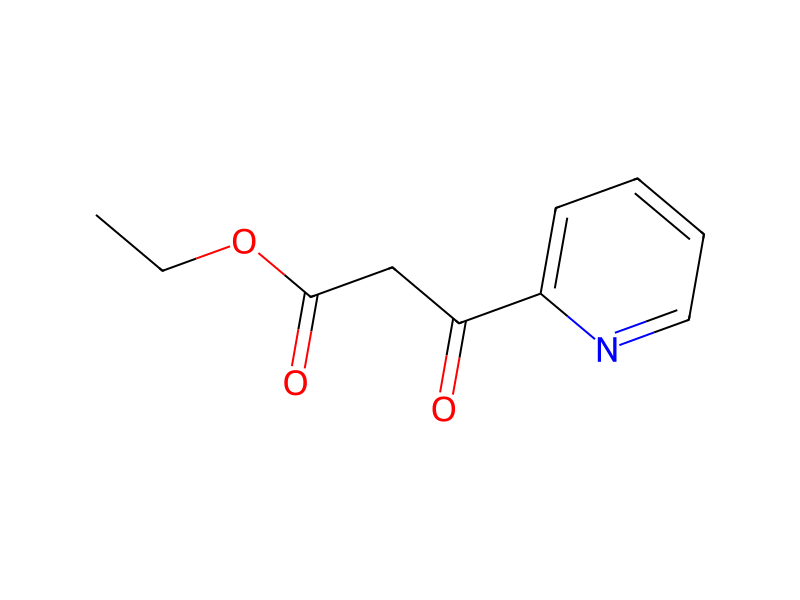
Place 1-aminopyrrolidin-2-one hydrochloride (Zubek, A. Z. Chem., 1969, 9(2), 58; 155.6 g, 1.14 mol) in a 3 L flask equipped with mechanical stirrer and nitrogen inlet. Add 3-oxo-3-pyridin-2-yl-propionic acid ethyl ester (Preparation 3-A; 200 g, 1.04 mol) and pyridine (400 mL). Stir the reaction mixture at room temperature for 20 h. Dilute the mixture with water (500 mL) and extract with toluene (2×500 mL). Combine the organic layers, dry (sodium sulfate), filter, and concentrate in vacuo to yield 280 g (98%) of the subtitled compound as a dark oil. MS ES+ m/e 276 (M+1).
Workup
- custom155.6 g, 1.14 mol) in a 3 L flask equipped with mechanical stirrer and nitrogen inlet
- extractionextract with toluene (2×500 mL)
- dry with materialCombine the organic layers, dry (sodium sulfate)
- filtrationfilter
- concentrationconcentrate in vacuo
Sources & evidence
- ORD record
- ord-71c2a20f2eeb4a50ad39f3c8d1e8cee5
- Source dataset
- uspto-grants-2008_05
- Patent number
- US07368445B2
Reaction notes
Loading…