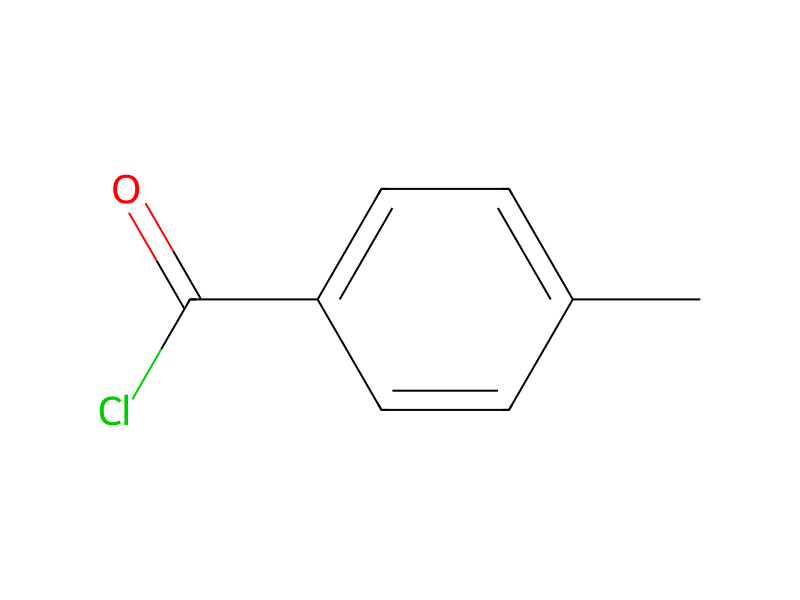
4-Methylbenzoyl Chloride → HCID 69020450, compound
Reaction equation

CC(C)(CNC(C[C@@H]1CC[C@@]2(O[C@]3(C4CC5C[C@@](O)(C4)CC3C5)OO2)CC1)=O)N.[OH:30][C:31]12[CH2:40][CH:35]3[CH2:36][CH:37]([CH2:39][CH:33]([C:34]3=[O:41])[CH2:32]1)[CH2:38]2.[C:42]1([CH3:51])[CH:47]=[CH:46][C:45]([C:48](Cl)=[O:49])=[CH:44][CH:43]=1>N1C=CC=CC=1>[C:42]1([CH3:51])[CH:47]=[CH:46][C:45]([C:48]([O:30][C:31]23[CH2:40][CH:35]4[CH2:36][CH:37]([CH2:39][CH:33]([C:34]4=[O:41])[CH2:32]2)[CH2:38]3)=[O:49])=[CH:44][CH:43]=1Participants
Reactant 3


Product 1

Reagents, catalysts & solvents 1

Conditions
- Temperature
- 0 °C
Procedure
cis, cis-5-Hydroxyadamantane-2-spiro-3′-8′-[[[(2′-amino-2′-methylpropyl)-amino]carbonyl]methyl]-1′,2′,4′-trioxaspiro[4.5]decane p-tosylate (OZ397). Step 1. To a mixture of 5-hydroxy-2-admantanone (5.0 g, 30 mmol) in pyridine (20 ml) at 0° C. was added a solution of p-toluoyl chloride (10.0 g, 65 mmol) in pyridine (20 ml). The reaction mixture was stirred at 0° C. for 5 h and at rt for 18 h. After removal of the solvent, the residue was diluted with water (50 ml) and extracted with EtOAc (3×30 ml). The combined organic layers were washed with H2O (2×20ml), dried over MgSO4, and evaporated to dryness. The residue was purified by chromatography (silica gel, 0 to 15% ether in hexanes) to afford the 5-p-toluoyloxy-2-adamantanone (7.7 g, 90%) as a white powder. 1H NMR (500 MHz, CDCl3) δ1.96-2.15 (m, 4H), 2.40 (s, 3H), 2.45-2.62 (m, 7H), 2.71 (s, 2H), 7.22 (d, J=8.3 Hz, 2H), 7.86 (d, J=8.3 Hz, 2H); 13C NMR (125.7 MHz, CDCl3) δ21.57, 29.86, 38.18, 39.96, 41.35, 47.04, 77.91, 128.47, 128.93, 129.46, 143.40, 165.40, 215.55. Step 2. To a mixture of 5-p-toluoyloxy-2-adamantanone (7.7 g, 27.1 mmol) and pyridine (10 ml) in ethanol (40 ml) was added methoxylamine hydrochloride (2.5 g, 30 mmol). The mixture was stirred at rt for 48 h, concentrated, diluted with water (50 ml), and extracted with EtOAc (3×30 ml). The EtOAc layers were combined, dried over MgSO4, and evaporated to dryness. The residue is purified by chromatography (silica gel, 10% ether in hexanes) to afford O-methyl 5-p-toluoyloxy-2-adamantanone oxime (8.0 g, 94%) as a white powder. 1H NMR (500 MHz, CDCl3) δ1.73-1.99 (m, 4H), 2.23-2.51 (m, 7H), 2.40 (s, 3H), 2.78 (s, 1H), 3.69 (s, 1H), 3.83 (s, 3H), 7.21 (d, J=7.8 Hz, 2H), 7.85 (d, J=7.8 Hz, 2H); 13C NMR (125.7 MHz, CDCl3) δ21.60, 30.39, 30.61, 36.39, 37.61, 37.85, 40.23, 40.53, 41.86, 61.10, 79.11, 128.81, 128.92, 129.47, 143.23, 163.60, 165.44. Step 3. A solution of O-methyl 5-p-toluoyloxy-2-adamantanone oxime (8.0 g, 25.5 mmol) and 4-(methoxycarbonylmethyl)cyclohexanone (7.5 g, 44 mmol) in cyclohexane (400 ml) and CH2Cl2 (100 ml) was treated with ozone according to the general procedure. After removal of the solvents, the crude product was purified by chromatography (silica gel, 0 to 20% ether in hexanes) to afford the trioxolane diester (mixture of four diastereomers, 6.5 g, 54%). Repeated chromatography (silica gel, 8% ether in hexanes) gave four fractions: isomers A+B (650 mg), isomer B (560 mg), isomers B+C (620 mg), and isomers C+D (550 mg). Crystallization of isomer B from acetone gave colorless single crystals. X-ray analysis established the configuration of isomer B as the trans, cis-diester. For isomer B: 1H NMR (500 MHz, CDCl3) δ1.19-1.31 (m, 2H), 1.62-1.96 (m, 11H), 2.27-2.17 (m, 9H), 2.39 (s, 3H), 2.46 (d, J=11.7 Hz, 2H), 3.67 (s, 3H), 7.20 (d, J=7.8 Hz, 2H), 7.86 (d, J=7.8 Hz, 2H); 13C NMR (125.7 MHz, CDCl3) δ21.58, 28.84, 29.84, 33.06, 33.42, 33.81, 38.28, 38.34, 40.30, 40.58, 51.46, 79.01, 108.93, 109.83, 128.87, 128.93, 129.43, 143.09, 165.49, 173.14. Repeated chromatography of the mixture of isomers B+C (silica gel, 8% ether in hexanes) gave isomer C (135 mg). The colorless single crystals obtained by crystallization from acetone were subjected to X-ray analysis that established the configuration of isomer C as the cis, cis-diester. 1H NMR (500 MHz, CDCl3) δ1.21-1.33 (m, 2H), 1.65-2.03 (m, 11H), 2.17-2.33 (m, 11H), 2.39 (s, 3H), 3.67 (s, 3H), 7.20 (d, J=8.3 Hz, 2H), 7.85 (d, J=8.3 Hz, 2H); 13C NMR (125.7 MHz, CDCl3) δ21.59, 29.22, 29.85, 33.09, 33.42, 33.75, 38.09, 38.44, 40.09, 40.57, 51.48, 78.59, 108.86, 109.87, 128.88, 128.96, 129.46, 143.10, 165.51, 173.18. Step 4. A mixture of the cis, cis-diester (95 mg, 0.202 mmol), EtOH (5 ml), THF (5 ml), and 1 M aq. NaOH (5 ml) was heated at 50 C for 18 h and then concentrated. The residue was dissolved in water (10 ml), washed with CH2Cl2 (3×5 ml), and acidified to pH=4 with 0.2 M aq. HCl. After the suspension was centrifuged, the supernatant was discarded. The solid pellet was dissolved in EtOH (3 ml) and the solution was centrifuged. The clear supernatant was collected, mixed with H2O (3 ml) and kept at 4° C. for 48 h. The crystals were collected by means of centrifugation and freeze dried to give the cis, cis-acid (55 mg, 81%) as colorless needles. 1H NMR (500 MHz, DMSO-d6) δ1.04-1.16 (m, 2H), 1.45-1.85 (m, 17H), 1.98 (brs, 3H), 2.11 (d, J=6.8 Hz, 2H), 4.48 (s, 1H), 12.04 (brs, 1H); 13C NMR (125.7 MHz, DMSO-d6) δ28.63, 29.60, 32.52, 33.37, 33.47, 37.59, 40.42, 41.98, 44.51, 65.12, 108.62, 110.10, 173.76. Step 5. A solution of the cis, cis-acid (50 mg, 0.15 mmol), HOSu (25 mg, 0.22 mmol), and EDCI (50 mg, 0.26 mmol) in DMF (3 ml) was stirred at rt for 24 h. Under ice cooling, the reaction was quenched with water (15 ml). The precipitate was collected by filtration, washed with cold water, and dried in a vacuum oven at 40° C. to give the cis, cis-active ester (53 mg, 83%) as a colorless solid. 1H NMR (500 MHz, CDCl3) δ1.34-1.46 (m, 2H), 1.56-2.06 (m, 17H), 2.14-2.21 (m, 3H), 2.56 (d, J=7.3 Hz, 2H), 2.88 (brs, 4H). Step 6. To a solution of 1,2-diamino-2-methylpropane (30 mg, 0.34 mmol) in CHCl3 (10 ml) was added dropwise a solution of the cis, cis-active ester (53 mg, 0.12 mmol) in CHCl3 (10 ml). The resulting mixture was stirred at rt for 3 h and then quenched with water (10 ml). After separation of the organic layer, the aqueous layer was extracted with CHCl3 (2×20 ml). The combined extracts were washed with water (2×10 ml) and brine (10 ml), dried over MgSO4, filtered, and concentrated. The residue was dissolved in CH2Cl2 (2 ml) and then a solution of p-toluenesulfonic acid monohydrate (19 mg) in ether (10 ml) was added. The precipitate was collected by filtration to afford trioxolane OZ397 (43 mg, 71%) as a colorless solid. mp 150-152 C; 1H NMR (500 MHz, DMSO-d6) δ1.04-1.20 (m, 2H), 1.16 (s, 6H), 1.44-1.82 (m, 17H), 1.94-2.02 (m, 3H), 2.07 (d, J=7.3 Hz, 2H), 2.29 (s, 3H), 3.19 (d, J=5.8 Hz, 2H), 4.47 (brs, 1H), 7.11 (d, J=8.3 Hz, 2H), 7.47 (d, J=7.8 Hz, 2H), 7.67 (brs, 3H), 8.05 (t, J=6.0 Hz, 1H); 13C NMR (125.7 MHz, DMSO-d6) δ20.94, 23.50, 28.61, 29.70, 33.35, 33.43, 37.58, 41.97, 44.50, 46.04, 54.54, 65.09, 108.65, 110.11, 125.66, 128.18, 137.66, 146.06, 172.55. Anal. Calcd for C29H44N2O8S: C, 59.98; H, 7.64; N, 4.82. Found: C, 59.97; H, 7.40; N, 4.93.
Workup
- customAfter removal of the solvent
- additionthe residue was diluted with water (50 ml)
- extractionextracted with EtOAc (3×30 ml)
- washThe combined organic layers were washed with H2O (2×20ml)
- dry with materialdried over MgSO4
- customevaporated to dryness
- customThe residue was purified by chromatography (silica gel, 0 to 15% ether in hexanes)
Sources & evidence
- ORD record
- ord-c384d2c3953c4a82a6c3a6a4bbdcd2f7
- Source dataset
- uspto-grants-2008_05
- Patent number
- US07371778B2
Reaction notes
Loading…