Sodium Tripolyphosphate → Pyrophosphate
Reaction equation

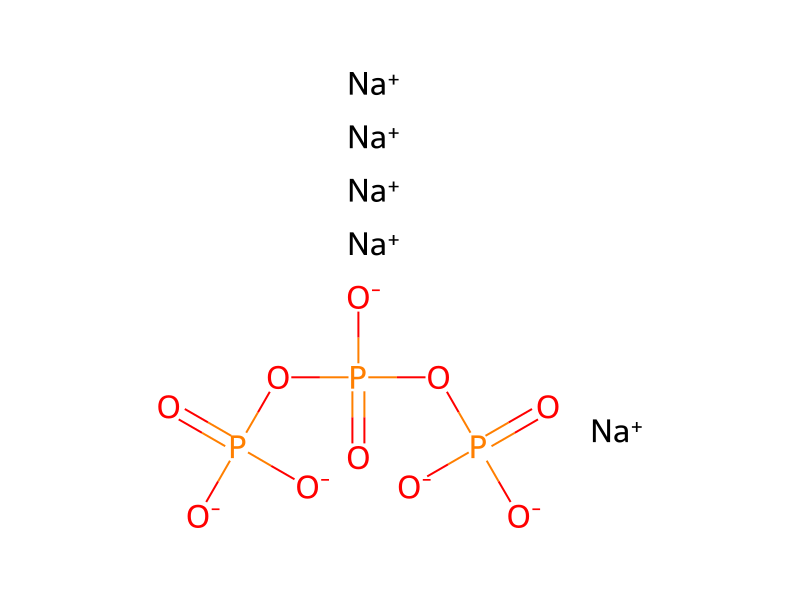
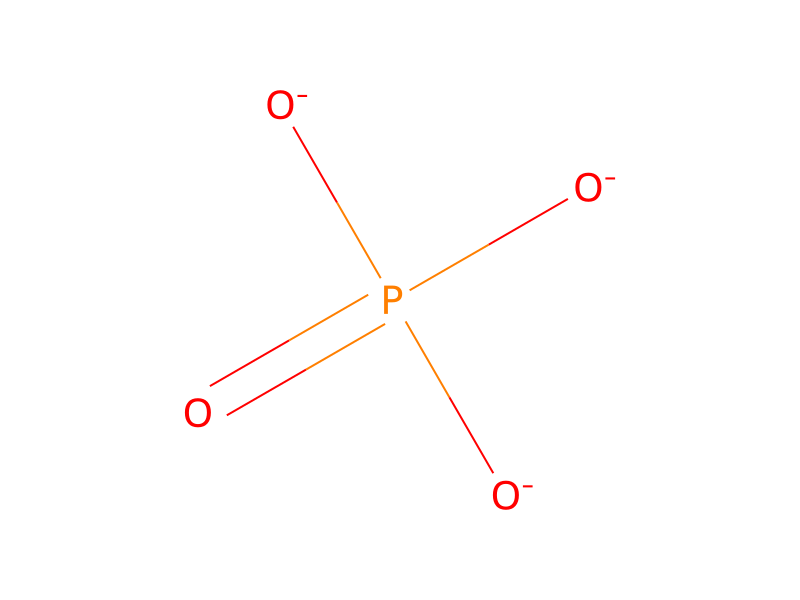
[O-:1][P:2]([O:5][P:6]([O:9]P([O-])([O-])=O)([O-:8])=[O:7])(=[O:4])[O-:3].[Na+].[Na+].[Na+].[Na+].[Na+]>O>[P:2]([O-:5])([O-:4])([O-:3])=[O:1].[O-:3][P:2]([O:5][P:6]([O-:9])([O-:8])=[O:7])(=[O:1])[O-:4]Participants
Reactant 1
Product 2

Reagents, catalysts & solvents 1

Procedure
The industrially important pentasodium triphosphate, Na5P3O10 (sodium tripolyphosphate) is a nonhygroscopic, white, water-soluble salt which is anhydrous or crystallizes with 6 H2O and has the general formula NaO—[P(O) (ONa)—O]n—Na where n=3. About 17 g of the crystalline anhydrous salt dissolve at room temperature in 100 g of water, approx. 20 g at 60°, and about 32 g at 100°; after heating the solution to 100° for two hours, about 8% orthophosphate and 15% diphosphate are formed by hydrolysis. In the case of the preparation of pentasodium triphosphate, phosphoric acid is reacted with sodium carbonate solution or sodium hydroxide solution in the stoichiometric ratio and the solution is dewatered by spraying. Similarly to Graham's salt and sodium diphosphate, pentasodium triphosphate dissolves many insoluble metal compounds (including lime soaps, etc.). Pentapotassium triphosphate, K5P3O10 (potassium tripolyphosphate), is commercially available, for example, in the form of a 50% by weight solution (>23% P2O5, 25% K2O). The potassium polyphosphates are widely used in the detergent industry.
Workup
- customcrystallizes with 6 H2O
- dissolutionAbout 17 g of the crystalline anhydrous salt dissolve at room temperature in 100 g of water
- customat 60°
- customat 100°
- temperatureafter heating the solution to 100° for two hours
Sources & evidence
- ORD record
- ord-bd8bcc2d13b2402098022fba7e1d43b9
- Source dataset
- uspto-grants-2008_05
- Patent number
- US07375070B2
Reaction notes
Loading…