Triphenylphosphine → Methyl 2-[3-(2-(2,4-dichlorophenyl)ethoxy)phenylthio]isobutyrate
Reaction equation

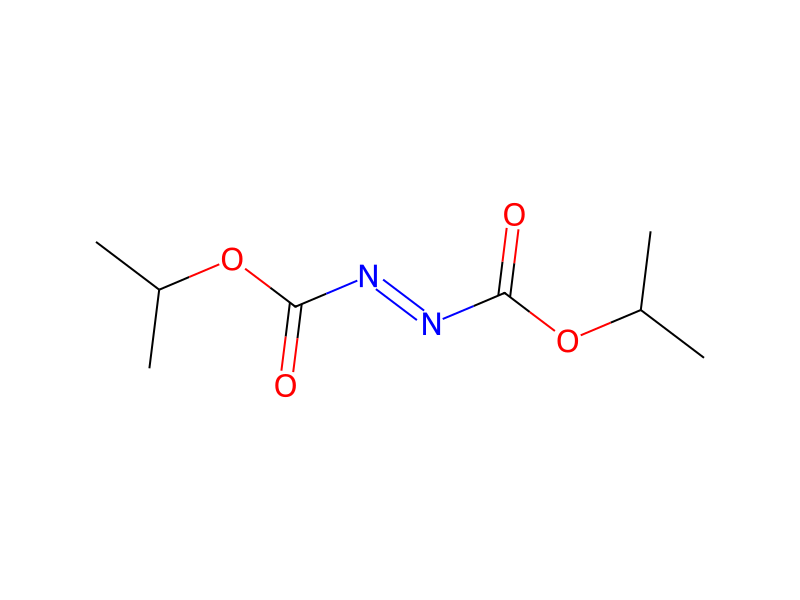
[OH:1][C:2]1[CH:3]=[C:4]([S:8][C:9]([CH3:15])([CH3:14])[C:10]([O:12][CH3:13])=[O:11])[CH:5]=[CH:6][CH:7]=1.CC(OC(/N=N/C(O[CH:27]([CH3:29])[CH3:28])=O)=O)C.[Cl:30][C:31]1[CH2:36][C:35]([Cl:40])(OCC)C=[CH:33][C:32]=1O.C1(P(C2C=CC=CC=2)C2C=CC=CC=2)C=CC=CC=1>C1COCC1>[Cl:40][C:35]1[CH:36]=[C:31]([Cl:30])[CH:32]=[CH:33][C:29]=1[CH2:27][CH2:28][O:1][C:2]1[CH:3]=[C:4]([S:8][C:9]([CH3:15])([CH3:14])[C:10]([O:12][CH3:13])=[O:11])[CH:5]=[CH:6][CH:7]=1Participants
Reactant 4



Product 1

Reagents, catalysts & solvents 1

Procedure
The title product was prepared according to the procedure described in Method B starting from methyl 2-(3-hydroxyphenylthio)iso-butyrate (prepared as described in example 1) (0.280 g, 1.24 mmol) and DIAD (0.325 g, 1.61 mmol) dissolved in 3 mL of anhydrous THF and added dropwise to a solution of 2,4-dichlorophenetylalcohol (0.260 g, 1.36 mmol), and triphenylphosphine (0.422 g, 1.61 mmol) in 4 mL of anhydrous THF at 0° C. The reaction was left overnight under magnetic stirring at room temperature. After this period, the solvent was evaporated and the residue purified by silica gel chromatography using hexane/AcOEt 9.6/0.4 as eluent. 0.327 g of oily product were obtained (yield: 66%); TLC: silica gel, eluent hexane/AcOEt 9/1, Fr: 0.34; 1H NMR (CDCl3, 300 MHz) δ: 7.40 (d, 1H), 7.20 (m, 3H), 7.00 (m, 2H), 6.90 (dd, 1H), 4.15 (t, 2H), 3.65 (s, 3H), 3.20 (t, 2H), 1.45 (s, 6H); HPLC: Column: Inertisil ODS—3 (5 μm) 4.6×250 mm, T: room temperature, mobile phase CH3CN/H2O 90/10 (v/v), pH: as is, flow rate: 0.8 mL/min, 205 nm UV detector, retention time 12.40 min; KF: 0.2% H2O; E.A. conforming for C19H20Cl2O3S.
Workup
- waitAfter this period
- customthe solvent was evaporated
- customthe residue purified by silica gel chromatography
Sources & evidence
- ORD record
- ord-47a33b91f2b244ca8d4d611aa2b86b14
- Source dataset
- uspto-grants-2008_05
- Patent number
- US07375124B2
Reaction notes
Loading…