Tyramine → Ethyl N-[2-(4-hydroxyphenyl)ethyl]carbamate
Reaction equation

Cl[C:2]([O:4][CH2:5][CH3:6])=[O:3].[NH2:7][CH2:8][CH2:9][C:10]1[CH:15]=[CH:14][C:13]([OH:16])=[CH:12][CH:11]=1.[OH-].[Na+]>O>[CH2:5]([O:4][C:2](=[O:3])[NH:7][CH2:8][CH2:9][C:10]1[CH:15]=[CH:14][C:13]([OH:16])=[CH:12][CH:11]=1)[CH3:6]Participants
Reactant 3
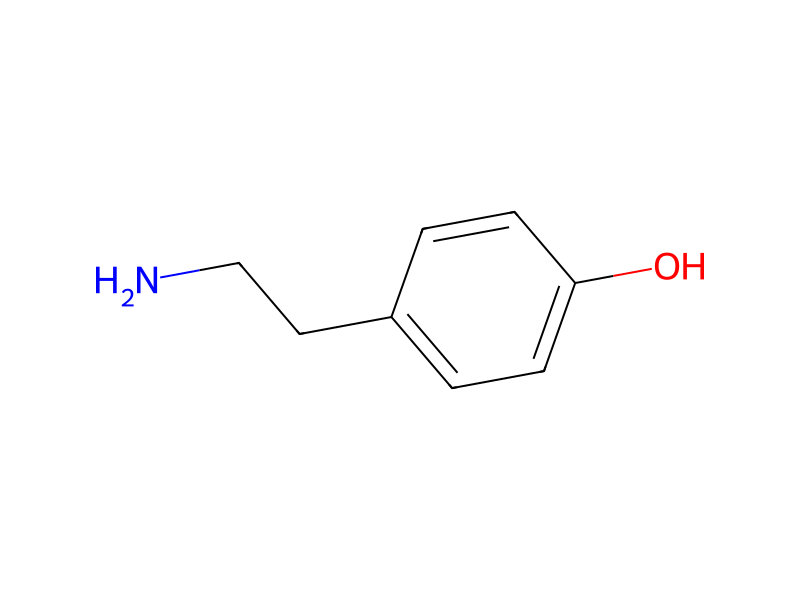


Product 1

Reagents, catalysts & solvents 1

Procedure
According to scheme 1, ethyl chloroformate is added to a solution of tyramine (1), sodium hydroxide, and water to produce the [2-(4-hydroxy-phenyl)-ethyl]-carbamic acid ethyl ester (2). The carbamate is treated with cesium carbonate and 4-fluorobenzonitrile in DMF to yield the corresponding biarylether 3. The nitrile functionality of the biaryl; ether 3 is converted to the N-acyl compound 4 by reaction with mrethyllithium followed by hydrolysis in aqueous sulfuric acid. The N-acyl compound 4 is converted to the acetate 5 by oxidation with m-chloroperbenzoic acid (MCPBA) in a suitable solvent. The acetate 5 is reduced with lithium aluminum hydride to afford the compound 4-[4-(2-methylamino-ethyl)-phenoxy]-phenol (6). The compound 6 is treated with benzaldehyde in the presence of sodium triacetoxyborohydride to produce the reductive amination product 4-{4-[2-(benzyl-methyl-amino)-ethyl]-phenoxy}-phenol 7 of formula I. Compounds of formula I wherein D is acetate and q is 0, may also be prepared according to scheme 2 below.
Sources & evidence
- ORD record
- ord-c6e26a200be2492d87b688b1a6415690
- Source dataset
- uspto-grants-2008_05
- Patent number
- US07378448B2
Reaction notes
Loading…