HuagongsheHuagongshe Chemistry Print Report · For research reference only
HRID 22256Generated: October 25, 2026
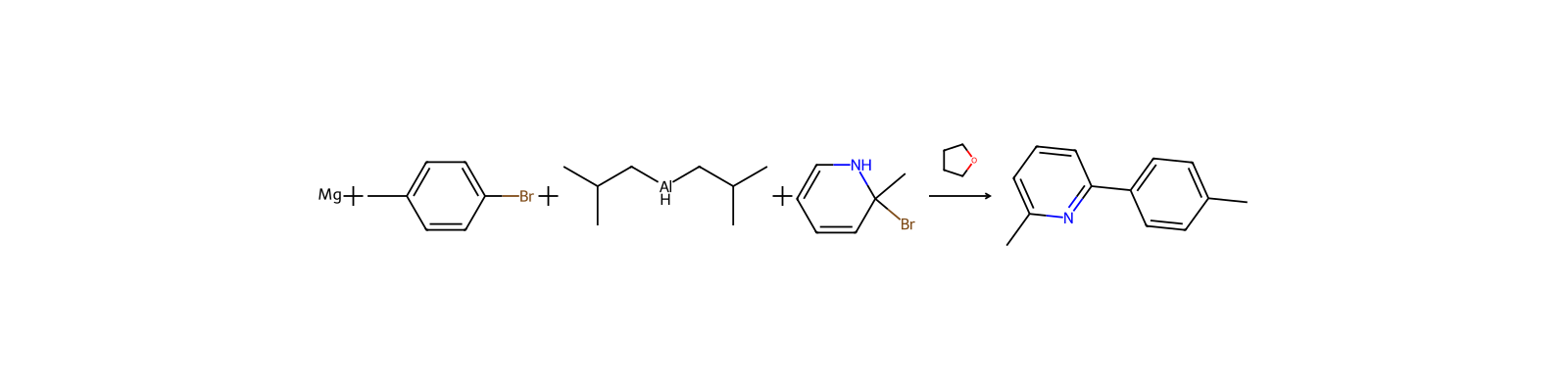
4-Bromotoluene → 2-Methyl-6-(4-methylphenyl)pyridine
https://huagongshe.com/reaction/22256
Participants
| Role | Name | HCID | Charge |
|---|
| Reactant | 4-Bromotoluene | HCID 7805 | — |
| Reactant | Diisobutylaluminum hydride | HCID 14487 | — |
| Reactant | Magnesium | HCID 5462224 | — |
| Reactant | 2-Bromopicoline | HCID 68644332 | — |
| Solvent | Tetrahydrofuran | HCID 8028 | — |
| Product | 2-Methyl-6-(4-methylphenyl)pyridine | HCID 603081 | — |
Reaction Steps
Magnesium (1.6 g) and p-bromotoluene (10.2 g) in 100 ml of tetrahydrofuran were stirred and warmed until the reaction commenced. When the exothermic reaction had finished, the mixture was refluxed for 1 hour. In a separate flask, a solution of palladium(II)bis(triphenylphosphine)dichloride (1.4 g) in 60 ml of tetrahydrofuran was prepared, and 4 ml of DIBAL (1M in toluene) added, followed by 2-bromopicoline (6.9 g). To this mixture, the magnesium reagent prepared above was added dropwise, causing an exothermic reaction. The reaction mixture was stirred overnight at room temperature, and then quenched by addition of ether/water. The mixture was washed with dilute hydrochloric acid, water, and then saturated brine. The organic layer was separated, dried over sodium sulfate, the solvent evaporated under reduced pressure, and the residue chromatographed on silica gel, eluting with 30-50% methylene chloride in heptane, to yield 4.5 g of 2-(4-methylphenyl)-6-methylpyridine, a compound of Formula (31), as an oil.
Provenance & Evidence
| DOI | 10.6084/m9.figshare.5104873.v1 |
|---|
| Patent number | US05428037 |
|---|
| Source dataset | uspto-grants-1995_06 |
|---|
| ORD ID | ord-69fa0b5b080547718031b61d69c72bad |
|---|
| Source note | uspto-grants-1995_06 |
|---|