6-Chlorouracil → 6-[3-(Hydroxymethyl)anilino]pyrimidine-2,4(1H,3H)-dione
Reaction equation

Cl[C:2]1[NH:7][C:6](=[O:8])[NH:5][C:4](=[O:9])[CH:3]=1.[NH2:10][C:11]1[CH:12]=[C:13]([CH:16]=[CH:17][CH:18]=1)[CH2:14][OH:15]>COCCO>[OH:15][CH2:14][C:13]1[CH:12]=[C:11]([CH:18]=[CH:17][CH:16]=1)[NH:10][C:2]1[NH:7][C:6](=[O:8])[NH:5][C:4](=[O:9])[CH:3]=1Participants
Reactant 2

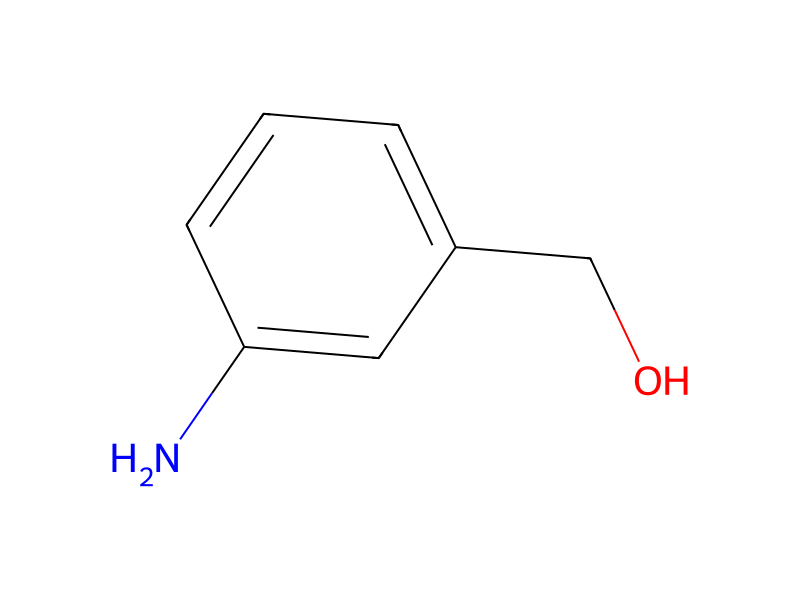
Product 1

Reagents, catalysts & solvents 1

Procedure
6-chlorouracil (1 mmol) and meta-aminobenzyl alcohol (2.0 mmol) were dissolved in 10 ml 2-methoxyethanol to form a reaction mixture. The mixture was then stirred at reflux for 10 hours to form 6-(meta-hydroxymethyl anilino)uracil with a yield of 86%. The hydroxy group was displaced by a bromo group by reacting the hydroxymethyl anilino-uracil (0.5 mmol) with 30% HBr in acetic acid (10 ml), thus forming 6-(meta-bromomethyl anilino)uracil with a yield of 90%. The bromo group was further replaced by a thiocyanate group by reacting 0.4 mmol 6-(meta-bromomethyl anilino)uracil with 2 mmol KSCN to form 6-(meta-mercaptocyanomethyl anilino)uracil (MMCMAU) with a yield of 80%. mMCMAU was then hydrolyzed to 6-(meta-thiomethyl anilino)uracil in 5 mL of 2N NaOH. The final product, 6-(meta-disulfidemethyl anilino)uracil, was formed quantitatively by reacting 6-(meta-thiomethyl anilino)uracil with methyl methane thiosulfonate in 2 molar excess.
Workup
- customto form a reaction mixture
- temperatureat reflux for 10 hours
Sources & evidence
- ORD record
- ord-47f1e66bff3845699552f0e633c262d6
- Source dataset
- uspto-grants-2002_07
- Patent number
- US06417180B1
Reaction notes
Loading…