Water → 3-(Thiophen-3-yl)benzaldehyde
Reaction equation

[S:1]1[CH:5]=[CH:4][C:3](B(O)O)=[CH:2]1.Br[C:10]1[CH:11]=[C:12]([CH:15]=[CH:16][CH:17]=1)[CH:13]=[O:14].C(=O)([O-])[O-].[Na+].[Na+].O>COCCOC.C1C=CC([P]([Pd]([P](C2C=CC=CC=2)(C2C=CC=CC=2)C2C=CC=CC=2)([P](C2C=CC=CC=2)(C2C=CC=CC=2)C2C=CC=CC=2)[P](C2C=CC=CC=2)(C2C=CC=CC=2)C2C=CC=CC=2)(C2C=CC=CC=2)C2C=CC=CC=2)=CC=1>[S:1]1[CH:5]=[CH:4][C:3]([C:10]2[CH:11]=[C:12]([CH:15]=[CH:16][CH:17]=2)[CH:13]=[O:14])=[CH:2]1Participants


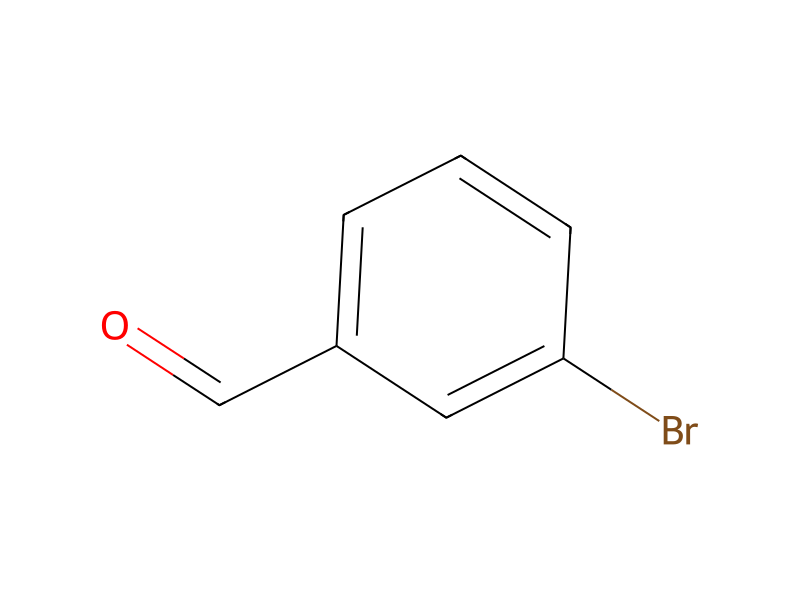




Conditions
- Temperature
- 80 °C
Procedure
3.11 g of 3-thiopheneboronic acid (0.024 mol) are added to a solution of 3-bromobenzaldehyde (3 g, 0.016 mol) in 1,2-dimethoxyethane (80 ml), followed by addition of aqueous 2N sodium carbonate solution (5.15 g, 0.048 mol) and a catalytic amount of tetrakis(triphenylphosphine)palladium (0.56 g, 4.9 10−4 mol). The reaction mixture is heated at 80° C. for 16 hours and is then cooled to room temperature and poured into water. The resulting mixture is extracted with ethyl acetate and the organic phase is washed with saturated aqueous sodium chloride solution. The organic phase is dried over magnesium sulfate and filtered, and the solvent is evaporated off under reduced pressure. The title product is isolated by chromatography on a column of silica (eluent: 90/10 cyclohexane/ethyl acetate). 2.61 g of a pale yellow solid are recovered.
Workup
- temperatureis then cooled to room temperature
- extractionThe resulting mixture is extracted with ethyl acetate
- washthe organic phase is washed with saturated aqueous sodium chloride solution
- dry with materialThe organic phase is dried over magnesium sulfate
- filtrationfiltered
- customthe solvent is evaporated off under reduced pressure
Sources & evidence
- ORD record
- ord-10b4d6e12b894b6c84fb6830cf10a512
- Source dataset
- uspto-grants-2002_07
- Patent number
- US06417222B1
Reaction notes
Loading…