2-Acetamidophenol → 2-(o-Bromobenzyloxy) aniline
Reaction equation

C([NH:4][C:5]1[CH:10]=[CH:9][CH:8]=[CH:7][C:6]=1[OH:11])(=O)C.[Br:12][C:13]1[CH:20]=[CH:19][CH:18]=[CH:17][C:14]=1[CH2:15]Br.[OH-].[K+]>C(O)C>[Br:12][C:13]1[CH:20]=[CH:19][CH:18]=[CH:17][C:14]=1[CH2:15][O:11][C:6]1[CH:7]=[CH:8][CH:9]=[CH:10][C:5]=1[NH2:4]Participants
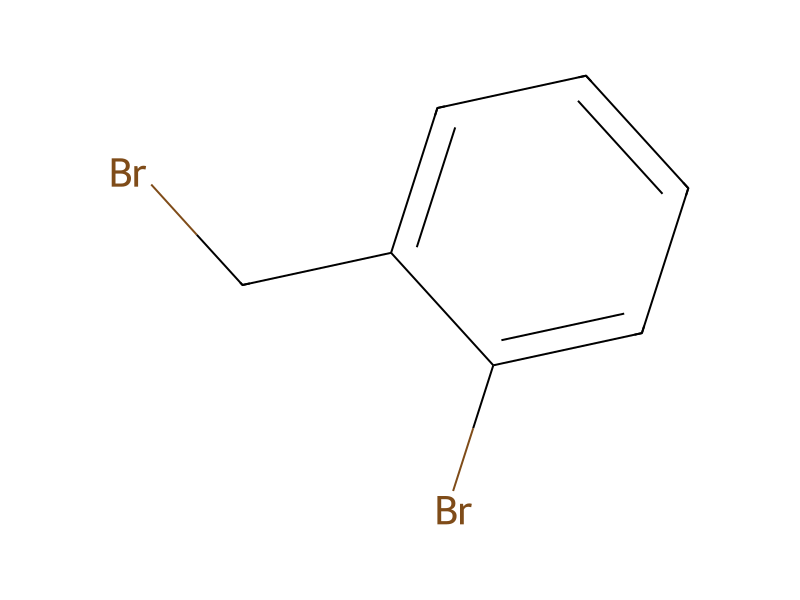
Reactant 3


Product 1

Reagents, catalysts & solvents 1

Procedure
To a 500 mL, 3-neck round-bottomed flask equipped with a mechanical stiffer, a condenser and a thermometer was charged 23.6 grains (0.156 mol) of 2-Acetamidophenol in 300 mL of ethanol (200 proof). 41.02 grams (0.164 mol) of 2-Bromobenzyl bromide was added, followed by the addition of 21.24 grains (1.09 molar equivalents) of potassium hydroxide (“KOH”) in a 45% aqueous solution which formed a clear reaction solution. The reaction solution was heated to reflux for several hours until the starting materials were consumed. Additional KOH (6.0 molar equivalents) was then added and the reaction mixture was further heated for several hours to form 2-(o-Bromobenzyloxy) aniline. The reaction mixture was cooled and about 3/4 of the ethanol was removed under vacuum at 30-40° C. Methyl-tert-butyl ether (“MTBE”) (200 mL) and water (300 mL) was added, the resulting layers were mixed and the lower aqueous layer was separated from the product-rich MTBE layer. The water layer was washed with MTBE (100 mL) and the MTBE layers were combined. The combined MTBE layers were washed with water (150 mL). Then, to the MTBE layers was added slowly 17.4 grams of HCl (1.0 molar equivalent) in a 37% aqueous solution to crystallize the product. The resulting crystal slurry was cooled to 0° C. and stirred for 1 hour. The crystals were filtered and washed with 30 mL of ice-cold ethanol and twice with 30 mL portions of ice-cold MTBE. The crystals were dried under nitrogen and vacuum to yield 41.5 grams (84% yield by weight) of 2-(o-Bromobenzyloxy) aniline HCl salt in 99.02% purity.
Workup
- customTo a 500 mL, 3-neck round-bottomed flask equipped with a mechanical stiffer, a condenser
- customformed a clear reaction solution
- temperatureThe reaction solution was heated
- temperatureto reflux for several hours until the starting materials
- customwere consumed
- additionAdditional KOH (6.0 molar equivalents) was then added
- temperaturethe reaction mixture was further heated for several hours
Sources & evidence
- ORD record
- ord-d1c0a6ced6d746cbbe0965b3d62a7537
- Source dataset
- uspto-grants-2002_07
- Patent number
- US06420606B1
Reaction notes
Loading…