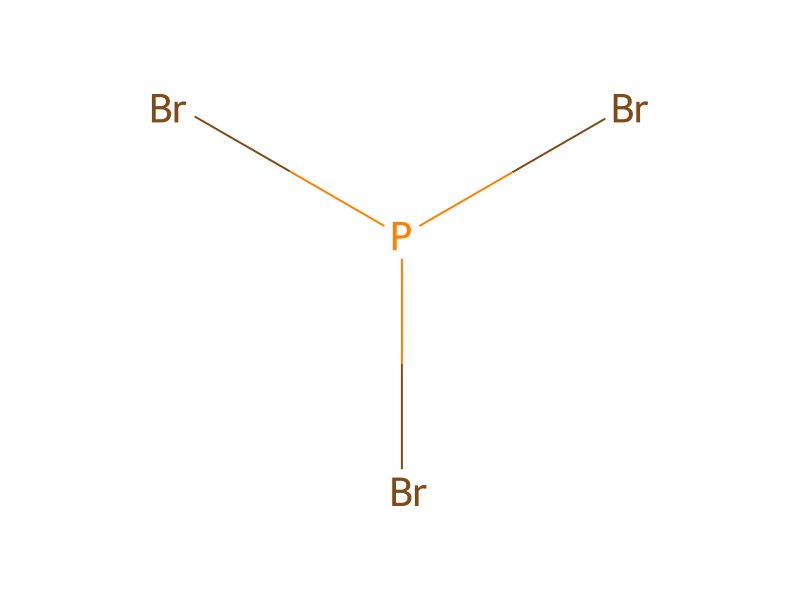
Phosphorus tribromide → 3-(6-Bromo-3-bromomethyl-2-fluoro-phenoxy)-5-chloro-benzonitrile
Reaction equation

P(Br)(Br)[Br:2].[Br:5][C:6]1[C:11]([O:12][C:13]2[CH:14]=[C:15]([CH:18]=[C:19]([Cl:21])[CH:20]=2)[C:16]#[N:17])=[C:10]([F:22])[C:9]([CH2:23]O)=[CH:8][CH:7]=1>C(Cl)Cl>[Br:5][C:6]1[C:11]([O:12][C:13]2[CH:14]=[C:15]([CH:18]=[C:19]([Cl:21])[CH:20]=2)[C:16]#[N:17])=[C:10]([F:22])[C:9]([CH2:23][Br:2])=[CH:8][CH:7]=1Participants
4



Procedure
A solution of PBr3 (0.74 mL of a 1 M solution in DCM, 1.1 equiv) was added to a solution of 107 (0.24 g, 0.67 mmol) in DCM (5 mL). The mixture was stirred at RT for 1 h and then concentrated in vacuo. The residue was dissolved in EtOAc, washed with saturated aqueous NaHCO3, and dried (MgSO4). Evaporation of the volatile materials afforded 0.17 g (60%) of 96.
Workup
- concentrationconcentrated in vacuo
- dissolutionThe residue was dissolved in EtOAc
- washwashed with saturated aqueous NaHCO3
- dry with materialdried (MgSO4)
- customEvaporation of the volatile materials
Sources & evidence
- ORD record
- ord-2567aa0444fe445ebe64dde2c4c5fd57
- Source dataset
- uspto-grants-2010_05
- Patent number
- US07713974B2
Reaction notes
Loading…