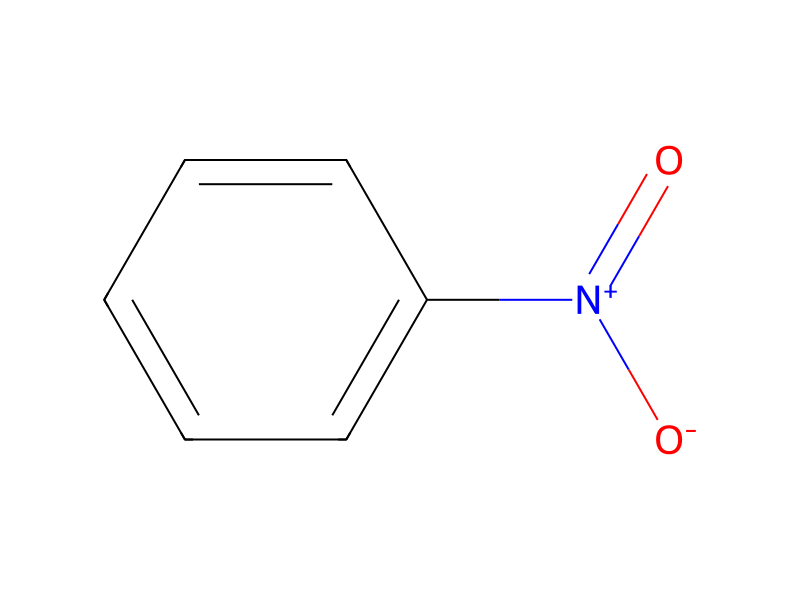
Nitrobenzene → 3,6-Dibromo-2-phenylazo-phenylamine
Reaction equation

[Br:1][C:2]1[C:3]([NH2:10])=[C:4]([NH2:9])[C:5]([Br:8])=[CH:6][CH:7]=1.[N+:11]([C:14]1[CH:19]=[CH:18][CH:17]=[CH:16][CH:15]=1)([O-])=O.[OH-].[Na+]>ClCCl>[Br:1][C:2]1[C:3]([N:10]=[N:11][C:14]2[CH:19]=[CH:18][CH:17]=[CH:16][CH:15]=2)=[C:4]([NH2:9])[C:5]([Br:8])=[CH:6][CH:7]=1Participants
5
Reactant 3


Product 1

Reagents, catalysts & solvents 1

Conditions
- Temperature
- 160 °C
Procedure
3,6-dibromo-1,2-phenylenediamine (1.33 g, 5.0 mmol), nitrobenzene (2.06 mL, 20 mmol), and sodium hydroxide (0.20 g, 5 mmol) were mixed in an 1-neck 100-mL round bottomed flask. The flask was heated in an oil bath at 160° C. for 3 h. The mixture was cooled to room temperature and dichloromethane was added to extract the product. The extract was filtered and the solution concentrated using a rotary evaporator. The solution was chromatographed on a silica gel column using dichloromethane as eluent. The fractions were combined and solvent removed under reduced pressure. The solid was further dried under high vacuum for 1 h. Yield: 3.5%.
Workup
- temperatureThe mixture was cooled to room temperature
- extractionto extract the product
- filtrationThe extract was filtered
- concentrationthe solution concentrated
- customa rotary evaporator
- customThe solution was chromatographed on a silica gel column
- customsolvent removed under reduced pressure
- customThe solid was further dried under high vacuum for 1 h
Sources & evidence
- ORD record
- ord-23b7854f47a84d968dec245f55e57f77
- Source dataset
- uspto-grants-2010_05
- Patent number
- US07714099B2
Reaction notes
Loading…