(4-Chlorophenyl)acetic acid → 4-Chlorophenylacetyl chloride
Reaction equation

[Cl:1][C:2]1[CH:7]=[CH:6][C:5]([CH2:8][C:9]([OH:11])=O)=[CH:4][CH:3]=1.S(Cl)([Cl:14])=O.BrBr>>[Cl:1][C:2]1[CH:7]=[CH:6][C:5]([CH2:8][C:9]([Cl:14])=[O:11])=[CH:4][CH:3]=1Participants
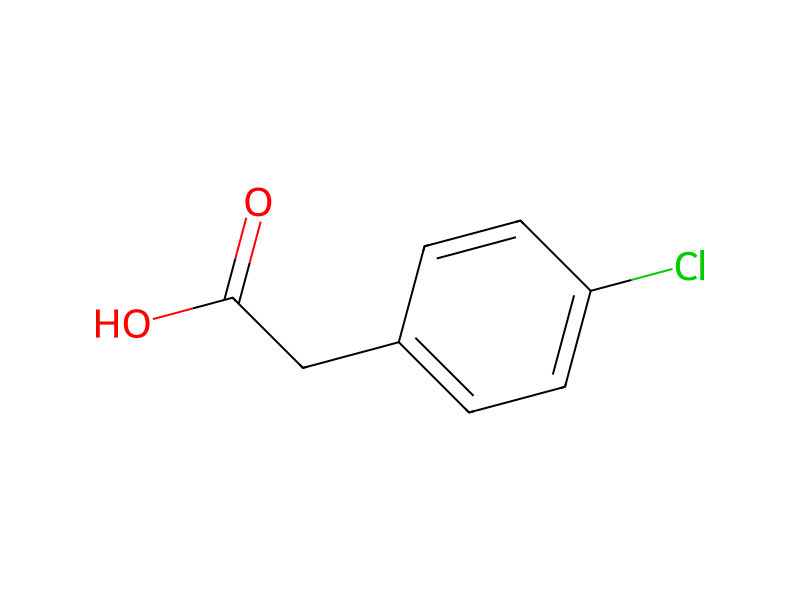



Procedure
For example, 4-chlorophenylacetic acid 1, can be treated with thionyl chloride to activate the carboxylic acid. This can then be treated with bromine to form 4-chlorophenylacetyl chloride. The esterification is conveniently carried out with (S)—N,N-tetramethylenelactamide 2. This reaction sequence is particularly advantageous as the reactions are conveniently carried out in one reaction vessel with only one isolation step. The displacement reaction of ester 3 with 3-trifluoromethylphenol 4 in the presence of potassium hydroxide gives α-(phenoxy)phenylacetic acid ester 5. Hydrolysis of the α-(phenoxy)phenylacetic acid ester 5 with lithium hydroxide afforded α-(phenoxy)phenylacetic acid 6. In this manner, (4-chlorophenyl)-(3-trifluoromethylphenoxy)-acetic acid, i.e., CPTA, can be prepared in five steps in about 73% yield following crystallization from heptane.
Sources & evidence
- ORD record
- ord-ed9636ba7e0d4d528980a4e08412cf8b
- Source dataset
- uspto-grants-2010_05
- Patent number
- US07714131B2
Reaction notes
Loading…