HuagongsheHuagongshe Chemistry Print Report · For research reference only
HRID 22440Generated: October 25, 2026
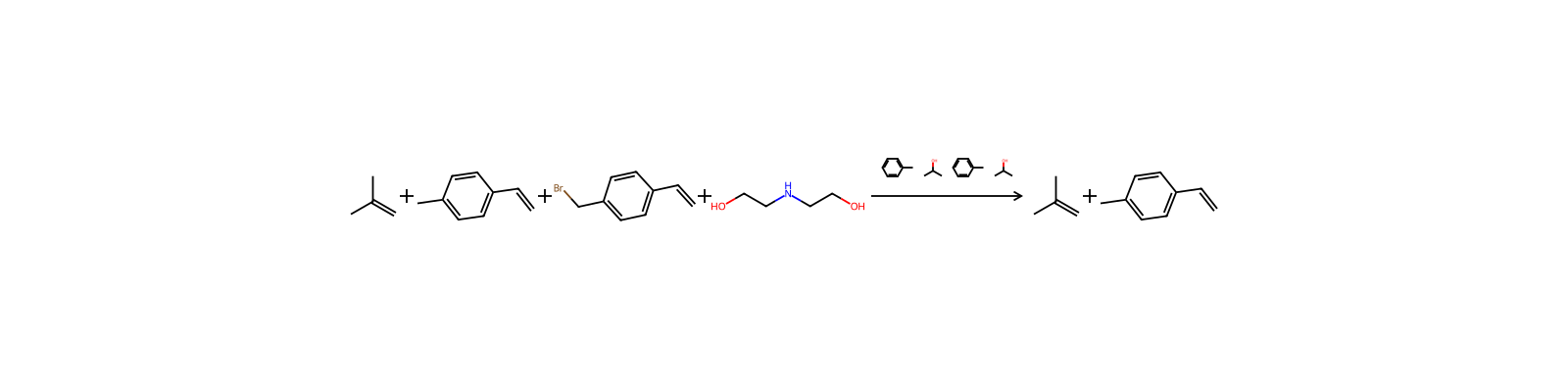
Diethanolamine → Isobutylene para-methylstyrene
https://huagongshe.com/reaction/22440
Participants
| Role | Name | HCID | Charge |
|---|
| Reactant | Diethanolamine | HCID 8113 | — |
| Reactant | Isobutylene p-methylstyrene p-bromomethylstyrene | HCID 69933008 | — |
| Solvent | Toluene | HCID 1140 | — |
| Solvent | Isopropanol | HCID 3776 | — |
| Solvent | Toluene isopropyl alcohol | HCID 21881414 | — |
| Product | Isobutylene para-methylstyrene | HCID 6454125 | — |
Reaction Steps
Isobutylene/para-methylstyrene/para-diethanolaminomethylstyrene copolymer was prepared in accordance with the technique of U.S. Pat. No. 5,162,445 which is incorporated by reference herein. In the nucleophilic substitution reaction, 500 g of isobutylene/p-methylstyrene/p-bromomethylstyrene copolymer (1.7 mole % p-methylstyrene, 0.7 mole % p-bromomethylstyrene 30 ML @ 125° C.) was dissolved in 2267 g of toluene in a 5-liter resin flask under nitrogen to form an 18 wt. % solution. Then 24.6 g diethanol amine (Aldrich, 99%) in 567 g of isopropanol was added slowly with stirring at room temperature to give a 14.9 wt % polymer solution in an 80/20 (weight/weight) toluene/isopropanol solvent blend. The solution was heated with stirring under nitrogen to reflux at about 87° C. for 3 hours before being allowed to cool. The polymer was recovered by precipitation and kneading in isopropanol. The recovered "wet" polymer was further purified by washing and kneading in a 50/50, water/methanol mixture to complete the removal of unreacted diethanolamine and then vacuum-oven dried at 70° C. for 48 hours with 0.2 wt. % BHT mixed as an antioxidant. The polymer was characterized by 'H NMR and showed the complete conversion of p-bromomethyl to diethanolaminomethyl functionality (0.7 mole % DEA).
Provenance & Evidence
| DOI | 10.6084/m9.figshare.5104873.v1 |
|---|
| Patent number | US05428099 |
|---|
| Source dataset | uspto-grants-1995_06 |
|---|
| ORD ID | ord-5869a5eee1ce43f6aeb8c115933dbd69 |
|---|
| Source note | uspto-grants-1995_06 |
|---|