Acrylic Acid → Acrylic acid sodium acrylate
Reaction equation

[C:1]([O-:5])(=[O:4])[CH:2]=[CH2:3].[Na+:6].[C:7]([OH:11])(=[O:10])[CH:8]=[CH2:9]>O>[C:1]([O-:5])(=[O:4])[CH:2]=[CH2:3].[Na+:6].[C:7]([OH:11])(=[O:10])[CH:8]=[CH2:9]Participants
Reactant 2

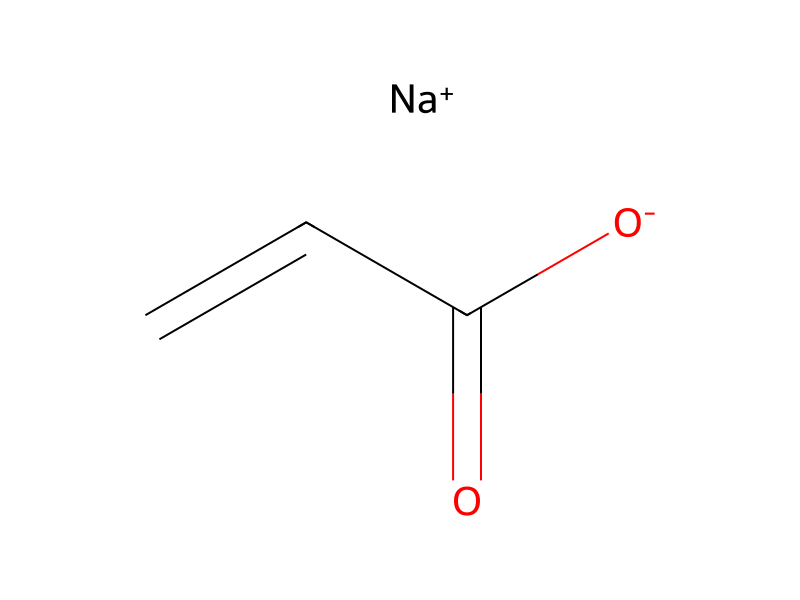
Product 1

Reagents, catalysts & solvents 1

Procedure
In 13.35 g of water, was dissolved 67.75 g of an aqueous sodium acrylate solution obtained in Production Example 3. The resulting solution was mixed with 8.9 g of acrylic acid to obtain 90 g of a 40% by weight aqueous sodium acrylate/acrylic acid=70/30 solution, to which 0.0992 g of N,N′-methylenebisacrylamide was added and dissolved as a crosslinking agent. The resulting solution was transferred to a 300 ml separable flask and purged with nitrogen at 30° C. for 30 minutes while being stirred. Polymerization was started by adding 0.0007 g of L-ascorbic acid and 0.046 g of ammonium persulfate, each being dissolved in 1 g of water, to the solution. After performing polymerization for 3 hours, a water-containing gel was obtained. The water-containing gel was crushed to a size of about 5 mm per side and dried at 150° C. for one hour in an inert oven under a nitrogen atmosphere. The dried polymer was milled by a homogenizer and then classified into particles having a particle size of 106 to 850 μm. The classified polymer in an amount of 100 parts was mixed with 2 parts of propylene glycol, 3 parts of water, and 30 parts of isopropyl alcohol, followed by heat treatment at 170° C. for 30 minutes. The resin obtained as described above was named as a comparative water-absorbing resin (4). The results of measurement of water absorption of the comparative water-absorbing resin (4) are shown in Table 2.
Workup
- customobtained in Production Example 3
Sources & evidence
- ORD record
- ord-6ff25dba9ca449f9a28e34a0755111ab
- Source dataset
- uspto-grants-2010_03
- Patent number
- US07683150B2
Reaction notes
Loading…