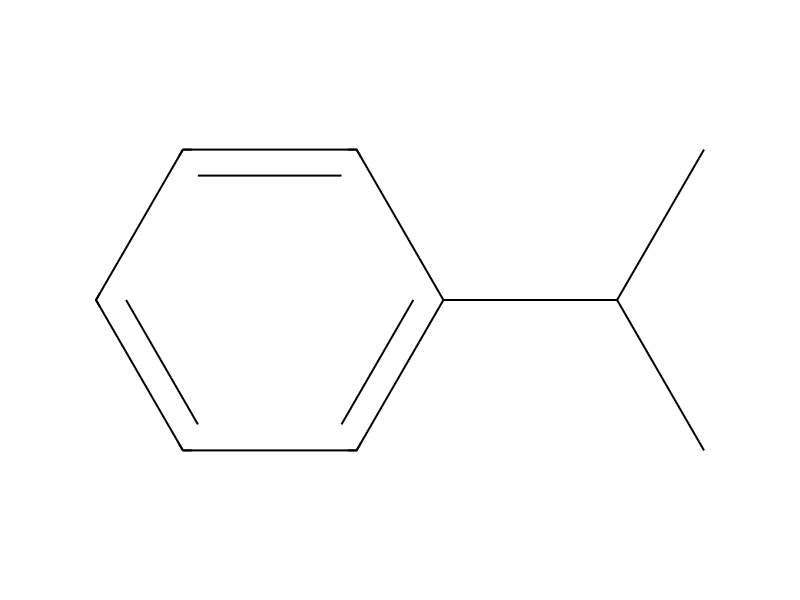
Benzene → Cumene
Reaction equation

[CH:1]1[CH:6]=[CH:5][CH:4]=[CH:3][CH:2]=1.[CH:7]1[CH:12]=CC=C[CH:8]=1.C1C=CC=CC=1>>[C:1]1([CH:7]([CH3:12])[CH3:8])[CH:6]=[CH:5][CH:4]=[CH:3][CH:2]=1Participants
Reactant 2


Product 1
Procedure
An embodiment of the present disclosure is depicted in FIG. 1. Referring to FIG. 1, naphtha is introduced via line 1 into reactor zone 3 where the naphtha is reformed or steam cracked into aromatic products including benzene. Although only one reactor zone is shown, there can be more than one reactor zone. In reactor zone 3, C4− hydrocarbons are removed from the reformate via line 4 and the remaining reformate is withdrawn from reactor zone 3 via line 5 and introduced into column 7 where the feed is fractionated to form a light reformate fraction, a heavy reformate fraction, and a benzene/benzene coboiler fraction. The light reformate fraction is withdrawn from column 7 through line 9, the heavy reformate fraction is withdrawn from column 7 through line 11, and the benzene/benzene coboiler fraction is withdrawn from column 7 through line 13 and introduced into zone 15. In zone 15, catalyst poisons, e.g., sulfur, nitrogen, olefins, dienes, or combinations thereof are at least partially removed from the benzene/benzene coboiler fraction. The resulting fraction is withdrawn from zone 15 via line 17 and introduced into propylation zone 18. In propylation zone 18, propylene is introduced via line 19 and benzene is reacted with the propylene to form cumene. Low molecular weight molecules, such as propane and propylene, are withdrawn from propylation zone 18 via line 20. The cumene-containing product is withdrawn from propylation zone 18 via line 21 and introduced into column 23. In column 23, the cumene-containing product is fractionated to form a C8− fraction and a C9+ fraction comprised of cumene and polypropylbenzenes. The C8− fraction is withdrawn from column 23 via line 25 and either removed from the unit via line 26 or recycled via line 17 to propylation zone 18. The C9+ fraction is withdrawn from column 23 via line 27 and introduced into column 29. In Column 29, the C9+ fraction is fractionated to form a high purity cumene product fraction and a C10+ fraction comprised of polypropylbenzenes and C16+ hydrocarbons. The C10+ fraction is withdrawn from column 29 via line 33. Recovered polypropylbenzenes have a high octane rating and are available for upgrading the value of mogas pool (can be blended into gasoline to increase its octane). The high purity cumene product fraction is withdrawn from column 29 via line 31 and recovered without need of further purification. The cumene product will usually have a purity that exceeds 99.50 percent by weight based on the total weight of the product.
Workup
- customIn reactor zone 3, C4− hydrocarbons are removed from the reformate via line 4
- customthe remaining reformate is withdrawn from reactor zone 3 via line 5
- additionintroduced into column 7 where the feed
- customto form a light reformate fraction
- customThe light reformate fraction is withdrawn from column 7 through line 9
- customthe heavy reformate fraction is withdrawn from column 7 through line 11
- customthe benzene/benzene coboiler fraction is withdrawn from column 7 through line 13
- additionintroduced into zone 15
- custompartially removed from the benzene/benzene coboiler fraction
- customThe resulting fraction is withdrawn from zone 15 via line 17
- additionintroduced into propylation zone 18
- additionIn propylation zone 18, propylene is introduced via line 19 and benzene
- customis reacted with the propylene
Sources & evidence
- ORD record
- ord-45b7eba3f9a54d2aa6371d866412d461
- Source dataset
- uspto-grants-2010_03
- Patent number
- US07683228B2
Reaction notes
Loading…