Ytterbium triflate → HCID 86613870, compound
Reaction equation

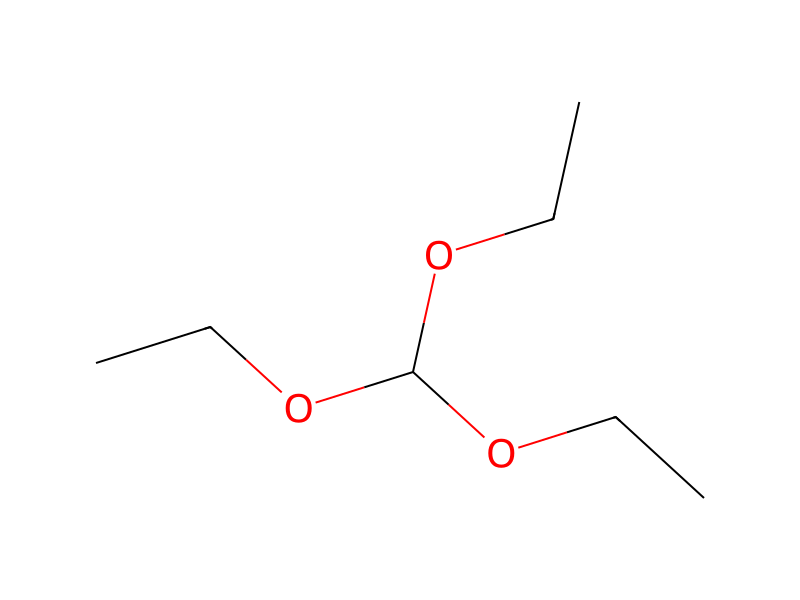
[O-]S(C(F)(F)F)(=O)=O.[Yb+3].[O-]S(C(F)(F)F)(=O)=O.[O-]S(C(F)(F)F)(=O)=O.[NH2:26][C:27]1[C:28]([C:37]#[N:38])=[N:29][C:30]([Cl:36])=[C:31](N)[C:32]=1CC>C(OCC)(OCC)OCC>[Cl:36][C:30]1[N:29]=[C:28]([C:37]#[N:38])[C:27]2[N:26]=[CH:28][N:29]([CH2:30][CH3:31])[C:32]=2[CH:31]=1Participants
4
Reactant 2


Product 1

Reagents, catalysts & solvents 1
Conditions
- Temperature
- 120 °C
Procedure
Ytterbium triflate (75 mg) was added to a solution of 3-amino-6-chloro-4-ethyl-amino-pyridine-2-carbonitrile (1.41 g) in triethyl orthoformate (50 mL). The mixture was heated at 120° C. under stirring for 2.5 hours, than concentrated under reduced pressure. The residue was chromatographed (eluent: dichloromethane/ethyl acetate 9/1) to yield a solid which was triturated with diethyl ether and filtered off to afford the title compound (0.973 g, 66%) as white crystals (mp=138° C.). 1H NMR (CDCl3) δ: 8.17 (s, 1H); 7.62 (s, 1H); 4.31 (q, J=8 Hz, 2H); 1.62 (t, J=8 Hz, 3H). 13C NMR (CDCl3) δ: 147.5, 143.8, 142.9, 141.7, 124.0, 114.1, 109.2, 40.9, 15.2.
Workup
- concentrationthan concentrated under reduced pressure
- customThe residue was chromatographed (eluent: dichloromethane/ethyl acetate 9/1)
- customto yield a solid which
- customwas triturated with diethyl ether
- filtrationfiltered off
Sources & evidence
- ORD record
- ord-bd48475c4b8f44f8a5b8166fc2e66151
- Source dataset
- uspto-grants-2010_03
- Patent number
- US07687515B2
Reaction notes
Loading…