4-Chloroaniline → 1-(4-Chloroanilino)-4-[2-(pyridin-3-yl)-ethyl]-isoquinoline
Reaction equation
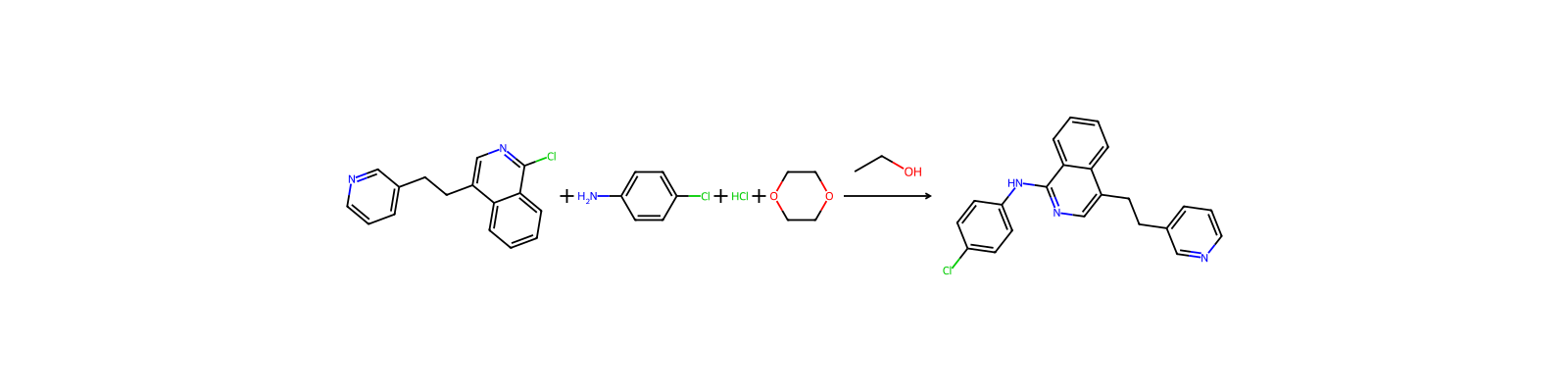
Cl[C:2]1[C:11]2[C:6](=[CH:7][CH:8]=[CH:9][CH:10]=2)[C:5]([CH2:12][CH2:13][C:14]2[CH:15]=[N:16][CH:17]=[CH:18][CH:19]=2)=[CH:4][N:3]=1.[Cl:20][C:21]1[CH:27]=[CH:26][C:24]([NH2:25])=[CH:23][CH:22]=1.Cl.O1CCOCC1>C(O)C>[Cl:20][C:21]1[CH:27]=[CH:26][C:24]([NH:25][C:2]2[C:11]3[C:6](=[CH:7][CH:8]=[CH:9][CH:10]=3)[C:5]([CH2:12][CH2:13][C:14]3[CH:15]=[N:16][CH:17]=[CH:18][CH:19]=3)=[CH:4][N:3]=2)=[CH:23][CH:22]=1Participants
5





Conditions
- Temperature
- 80 °C
Procedure
Under an N2 atmosphere, 250 mg (0.93 mmol) of 1-chloro-4-(2-pyridin-3-yl-ethyl)isoquinoline in 2.9 ml of abs. ethanol are mixed with 131 mg (1.02 mmol) of 4-chloro-aniline and 0.23 ml of 4 N HCl/dioxane, and stirred for 8 h at 80° C. The mixture is cooled to RT, filtered and the residue washed with acetonitrile. The residue is dissolved in 4 ml of water, then 0.9 ml of sat. NH3 solution are added, stirring is effected for 10 min, the precipitate is filtered off and washed with water. Recrystallisation from acetonitrile yields 1-(4chloroanilino)-4-[2-(pyridin-3-yl)-ethyl]-isoquinoline; m.p.157-158° C.
Workup
- temperatureThe mixture is cooled to RT
- filtrationfiltered
- washthe residue washed with acetonitrile
- dissolutionThe residue is dissolved in 4 ml of water
- addition0.9 ml of sat. NH3 solution are added
- stirringstirring
- waitis effected for 10 min
- filtrationthe precipitate is filtered off
- washwashed with water
- customRecrystallisation from acetonitrile
Sources & evidence
- ORD record
- ord-0ea4557aadfb42a3a49e1fed8ceb96e5
- Source dataset
- uspto-grants-2008_01
- Patent number
- US07323474B2
Reaction notes
Loading…