Sodium Hydroxide → Sodium orthosilicate
Reaction equation

[O:1]=[Si]=O.[OH-].[Na+:5].[O-:6][Si:7]([O-:9])=[O:8].[Na+].[Na+]>O>[Si:7]([O-:1])([O-:9])([O-:6])[O-:8].[Na+:5].[Na+:5].[Na+:5].[Na+:5]Participants
Reactant 3


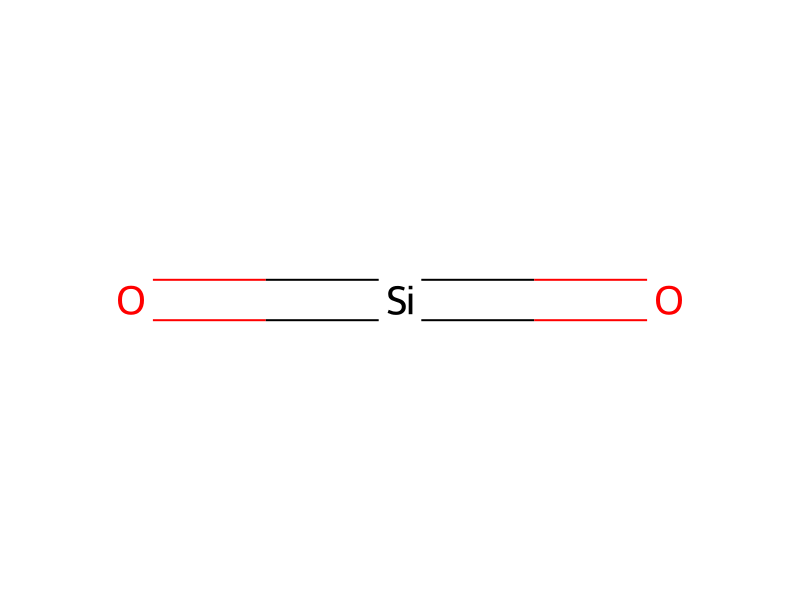
Product 1

Reagents, catalysts & solvents 1

Procedure
For producing crystalline sodium silicates having a layer structure, an SiO2 /Na2O molar ratio of (1.9 to 2.1):1 and a water content of less than 0.3% by weight from a waterglass solution containing at least 20% by weight of solids, the waterglass solution is obtained by reacting quartz sand with sodium hydroxide solution at an SiO2 /Na2O molar ratio of (2.0 to 2.3):1 at temperatures of 180° to 240° C. and pressures of 10 to 30 bar. This waterglass solution is treated in a spray-drying zone with hot air at 200° to 300° C. for a residence time of 10 to 25 seconds and at a temperature of the exit gas leaving the spray-drying zone of 90° to 130° C., to form a pulverulent amorphous sodium silicate having a water content (determined as the loss on ignition at 700° C.) of 15 to 23% by weight and a bulk density of more than 300 g/l. The pulverulent, amorphous, water-containing sodium silicate is introduced into an obliquely arranged rotary kiln fitted with devices for moving solids and treated therein with flue gas in countercurrent at temperatures from more than 500° up to 850° C. for 1 to 60 minutes to form crystalline soidium silicate. The rotary kiln is here insulated in such a way that its outside wall temperature is less than 60° C. Finally, the crystalline sodium silicate emerging from the rotary kiln is comminuted by means of a mechanical crusher to grain sizes of 0.1 to 12 mm.
Workup
- customat temperatures of 180° to 240° C. and pressures of 10 to 30 bar
- customleaving the spray-drying zone of 90° to 130° C.
Sources & evidence
- ORD record
- ord-2dfcc948237a41caa775130ec9e1b875
- Source dataset
- uspto-grants-1993_08
- Patent number
- US05236682
Reaction notes
Loading…