Diazomethane → HCID 15659342, compound
Reaction equation
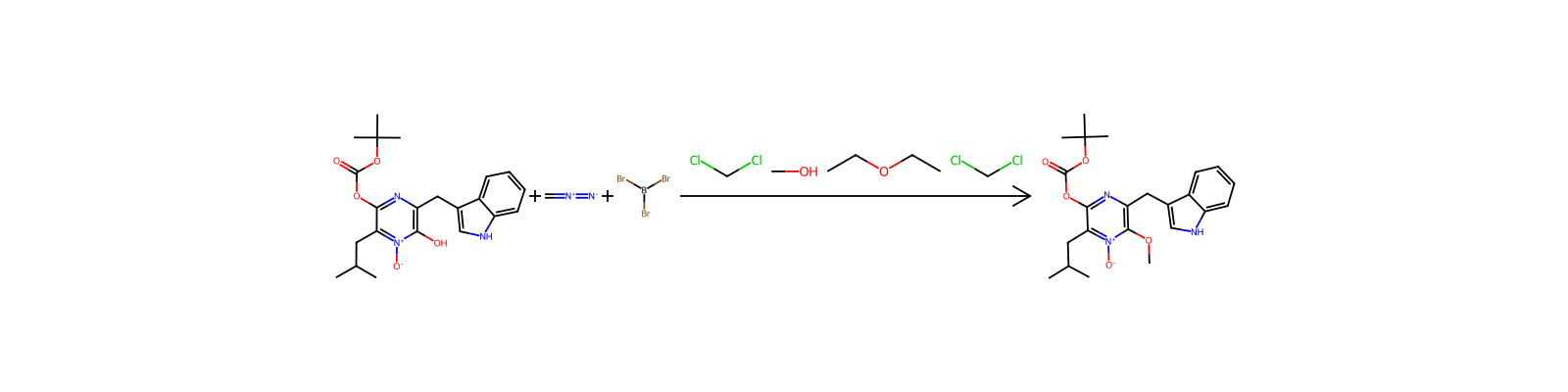
[C:1]([O:5][C:6]([O:8][C:9]1[C:10]([CH2:27][CH:28]([CH3:30])[CH3:29])=[N+:11]([O-:26])[C:12]([OH:25])=[C:13]([CH2:15][C:16]2[C:24]3[C:19](=[CH:20][CH:21]=[CH:22][CH:23]=3)[NH:18][CH:17]=2)[N:14]=1)=[O:7])([CH3:4])([CH3:3])[CH3:2].[N+](=[CH2:33])=[N-].B(Br)(Br)Br>ClCCl.CO.C(OCC)C.C(Cl)Cl>[C:1]([O:5][C:6]([O:8][C:9]1[C:10]([CH2:27][CH:28]([CH3:30])[CH3:29])=[N+:11]([O-:26])[C:12]([O:25][CH3:33])=[C:13]([CH2:15][C:16]2[C:24]3[C:19](=[CH:20][CH:21]=[CH:22][CH:23]=3)[NH:18][CH:17]=2)[N:14]=1)=[O:7])([CH3:4])([CH3:3])[CH3:2]Participants







Procedure
In 0.5 ml of dichloromethane-methanol (3:1) was dissolved 10 mg of 3-tert-butoxycarbonyloxy-6-hydroxy-5-(indol-3-yl)methyl-2-isobutylpyrazine 1-oxide. Thereto were added, under ice cooling, a solution of diazomethane dissolved in diethyl ether and 4-5 drops of a solution of 0.1 M of boron tribromide dissolved in methylene chloride. The container was cook-stoppered and the contents were stirred for 12 hours at room temperature. The contents were then diluted with 5 ml of dichloromethane, and the mixture was washed with an aqueous sodium hydrogen carbonate solution and dried over sodium sulfate. The solvent was removed by evaporation under reduced pressure. The residue was purified by a silica gel thin layer chromatography (dichloromethane:methanol=40:1) to obtain 3.6 mg of the title compound as a pale brown solid substance.
Workup
- additionThereto were added, under ice cooling
- washthe mixture was washed with an aqueous sodium hydrogen carbonate solution
- dry with materialdried over sodium sulfate
- customThe solvent was removed by evaporation under reduced pressure
- customThe residue was purified by a silica gel thin layer chromatography (dichloromethane:methanol=40:1)
Sources & evidence
- ORD record
- ord-a060c7b408d346f1b4fda7b5c966f581
- Source dataset
- uspto-grants-1993_08
- Patent number
- US05238938
Reaction notes
Loading…