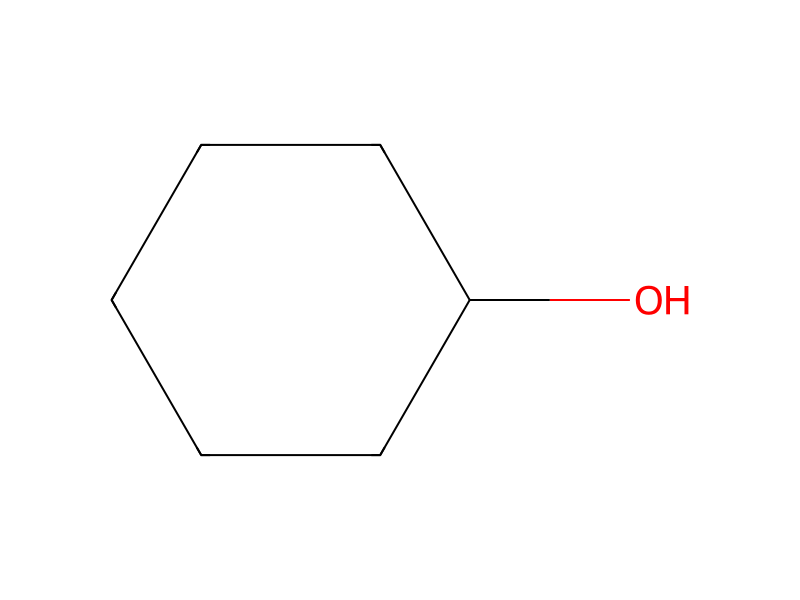
Cyclohexyl formate → Cyclohexanol
Reaction equation

[CH:1]([O:3][CH:4]1[CH2:9][CH2:8][CH2:7][CH2:6][CH2:5]1)=[O:2]>O>[CH:1]([O:3][CH:4]1[CH2:9][CH2:8][CH2:7][CH2:6][CH2:5]1)=[O:2].[CH:4]1([OH:3])[CH2:9][CH2:8][CH2:7][CH2:6][CH2:5]1Participants
5
Reactant 2


Product 2
Reagents, catalysts & solvents 1

Conditions
- Temperature
- 110 °C
Procedure
Using a procedure analogous to that employed in Example 1, 1.28 g of cyclohexyl formate, 1.8 g of water, and 0.5 g of a sulfonated polytetrafluoroethylene were heated at 110° C. over a period of 2 h. Following separation of the catalyst and homogenization with acetone there were obtained, in addition to unconverted cyclohexyl formate, 70.2 mol % of cyclohexanol, and the only by-product was 1.8 mol % of cyclohexene.
Workup
- customseparation of the catalyst and homogenization with acetone
Sources & evidence
- ORD record
- ord-31231c9307f342118c2a247229c11b9e
- Source dataset
- uspto-grants-1995_12
- Patent number
- US05475158
Reaction notes
Loading…