Phosphoric Acid → 1,2-Dichloro-4-nitrobenzene
Reaction equation

[N+:1]([O-:4])([OH:3])=[O:2].OS(O)(=O)=O.OP(O)(O)=O.[Cl:15][C:16]1[CH:21]=[CH:20][CH:19]=[CH:18][C:17]=1[Cl:22]>>[Cl:15][C:16]1[CH:21]=[C:20]([N+:1]([O-:4])=[O:2])[CH:19]=[CH:18][C:17]=1[Cl:22].[Cl:15][C:16]1[C:17]([Cl:22])=[CH:18][CH:19]=[CH:20][C:21]=1[N+:1]([O-:3])=[O:2]Participants


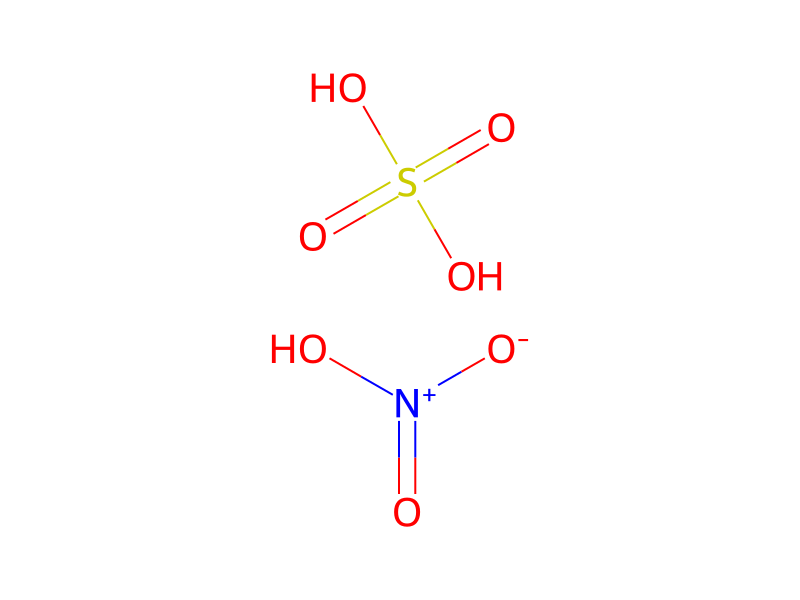


Procedure
If nitration is carried out in the hitherto known manner in an HNO3 /H2SO4 mixture without addition of H3PO4, in the nitration of 1,2-dichlorobenzene the two isomers are typically formed in approximately 98.5% yield in a ratio of 3,4-dichloro- 1-nitrobenzene to 2,3-dichloro- 1-nitrobenzene of 8.2:1. If 1,2-dichlorobenzene is nitrated using phosphoric acid which is concentrated to 104%, simultaneously dispensing with sulphuric acid and with additional use of nearly anhydrous nitric acid, then a shift in favour of the 2,3-isomer is obtained. The ratio 3,4-: 2,3-dichloro-1-nitrobenzene accordingly falls to values of 5.95 or 5.45, depending slightly on the reaction temperature, as was found by our own experiments. The term 104% strength H3PO4 signifies a concentrated, i.e. dehydrated, phosphoric acid, which contains a proportion of pyrophosphoric acid and accordingly has a P2O5 content which corresponds to 104% H3PO4. The serious disadvantage of such a procedure is the great fall in the yield to 89% or even 86% as a specific function of the reaction temperature.
Sources & evidence
- ORD record
- ord-65cf3b482d524e328529e8680777b1a2
- Source dataset
- uspto-grants-1995_12
- Patent number
- US05475163
Reaction notes
Loading…