Propargyl ether → (1,3-Dihydro-2-benzofuran-5-yl)methanol
Reaction equation

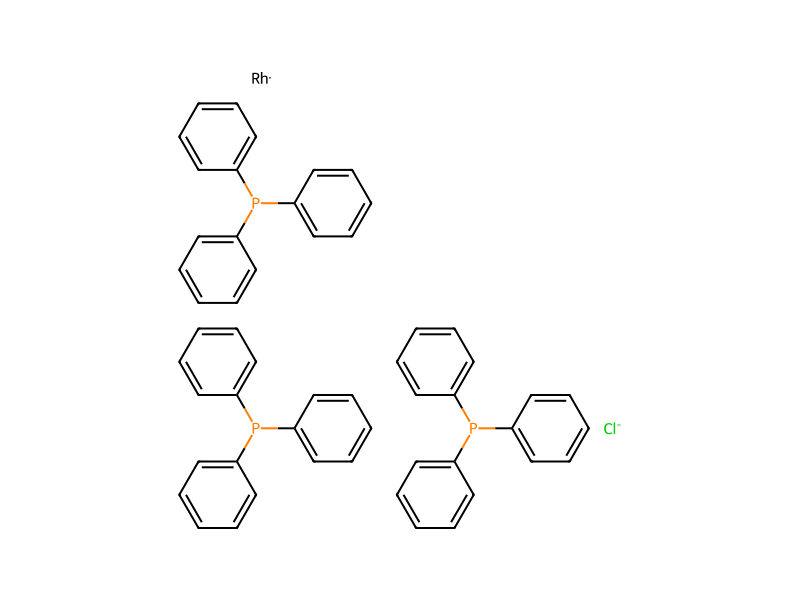
[CH2:1]([O:4][CH2:5][C:6]#[CH:7])[C:2]#[CH:3]>C(O)C.C1C=CC(P(C2C=CC=CC=2)C2C=CC=CC=2)=CC=1.C1C=CC(P(C2C=CC=CC=2)C2C=CC=CC=2)=CC=1.C1C=CC(P(C2C=CC=CC=2)C2C=CC=CC=2)=CC=1.[Cl-].[Rh]>[CH2:1]1[C:2]2[C:6](=[CH:7][C:2]([CH2:1][OH:4])=[CH:3][CH:3]=2)[CH2:5][O:4]1Participants
4
Reactant 1

Product 1

Reagents, catalysts & solvents 2

Conditions
- Temperature
- 70 °C
Procedure
In a round bottom flask with reflux condenser were placed 1.0 g of 3-Prop-2-ynyloxy-propyne and 2.08 g of propargylic alcohol in 10 ml ethanol, followed by the addition of 9.8 mg of tris(triphenylphosphine)rhodium chloride (Wilkinson catalyst) at room temperature. The reaction was heated up to 70° C., while the reaction colour turned yellow rapidly. After 1 day stirring at r.t., TLC analysis showed complete conversion of the starting material. The solvent was evaporated, diluted with DCM and extracted with H2O, dried over MgSO4. The brown mixture was purified by flash chromatography using 8/2 cyclohexane/AcOEt as mobile phase affording (1,3-Dihydro-isobenzofuran-5-yl)-methanol as a colourless pure solid (0.92 g, 60%).
Workup
- temperatureIn a round bottom flask with reflux condenser
- customThe solvent was evaporated
- additiondiluted with DCM
- extractionextracted with H2O
- dry with materialdried over MgSO4
- customThe brown mixture was purified by flash chromatography
Sources & evidence
- ORD record
- ord-69feb90868a14fc5917c6a2aa2b6f358
- Source dataset
- uspto-grants-2010_12
- Patent number
- US07846925B2
Reaction notes
Loading…