Sulfuric Acid → N~2~-Dodecanoyl-L-glutamine
Reaction equation

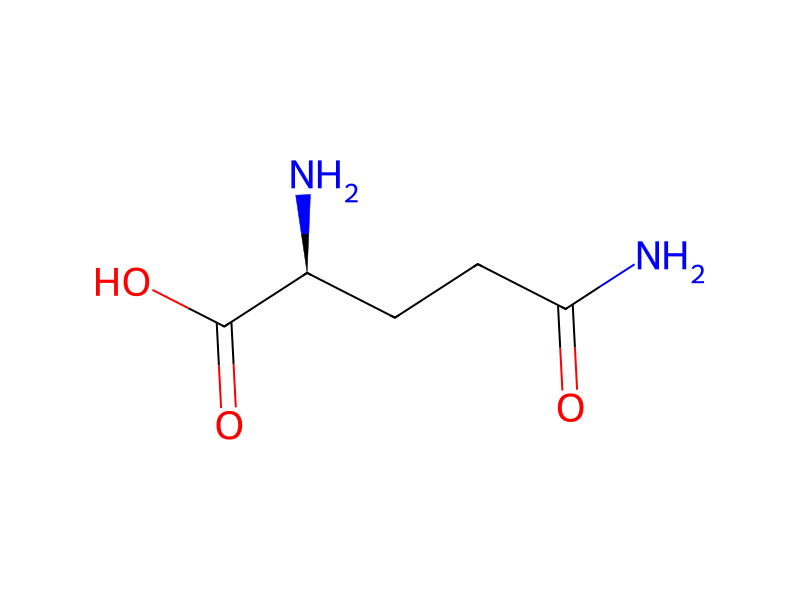
[NH2:1][C@H:2]([C:8]([OH:10])=[O:9])[CH2:3][CH2:4][C:5](=[O:7])[NH2:6].[OH-].[Na+].[C:13](Cl)(=[O:25])[CH2:14][CH2:15][CH2:16][CH2:17][CH2:18][CH2:19][CH2:20][CH2:21][CH2:22][CH2:23][CH3:24].S(=O)(=O)(O)O>O.CC(C)=O>[C:13]([NH:1][C@H:2]([C:8]([OH:10])=[O:9])[CH2:3][CH2:4][C:5](=[O:7])[NH2:6])(=[O:25])[CH2:14][CH2:15][CH2:16][CH2:17][CH2:18][CH2:19][CH2:20][CH2:21][CH2:22][CH2:23][CH3:24]Participants
Reactant 4



Product 1

Reagents, catalysts & solvents 2


Procedure
108 g of L-glutamine was dissolved in 343 g of water and 102 g of aqueous 27% sodium hydroxide solution, and cooled to 10° C. 138 g of acetone was added to it, and 152 g of lauroyl chloride and 108 g of aqueous 27% sodium hydroxide solution were dropwise added thereto. The acylation liquid was diluted with 300 g of water, then neutralized with 35 g of 75% sulfuric acid and filtered to obtain a white powdery substance, N-lauroyl-L-glutamine. 72.4 g of thionyl chloride was dropwise added to 424 g of isopropyl alcohol, then 100 g of N-lauroyl-L-glutamine was added thereto and reacted at room temperature for 8.5 hours. The reaction liquid was added to 2.0 L of water to precipitate the intended product, and this was taken out by filtration to obtain a crude product. This was recrystallized repeatedly three times with acetone to obtain 59.1 g of N-lauroyl-L-glutamine isopropyl ester.
Workup
- additionwere dropwise added
- filtrationfiltered
Sources & evidence
- ORD record
- ord-9d2cf65b8ed84d2aa36f8c1514cc04e8
- Source dataset
- uspto-grants-2010_12
- Patent number
- US07850955B2
Reaction notes
Loading…