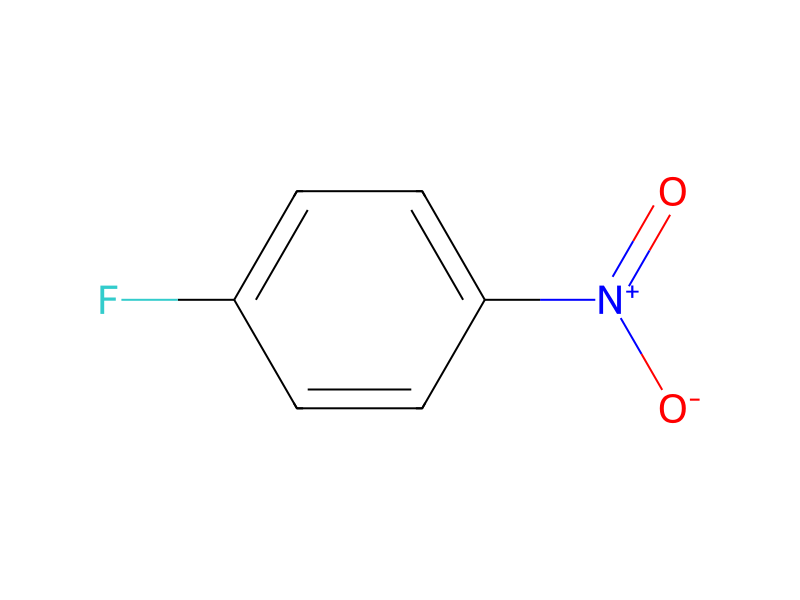
p-Fluoronitrobenzene → HCID 25132122, compound
Reaction equation

[Cl:1][C:2]1[CH:7]=[CH:6][C:5]([C:8]2[C:12]([C:13]3[N:14]=[CH:15][NH:16][CH:17]=3)=[C:11]([C:18]([F:21])([F:20])[F:19])[O:10][N:9]=2)=[CH:4][CH:3]=1.F[C:23]1[CH:28]=[CH:27][C:26]([N+:29]([O-:31])=[O:30])=[CH:25][CH:24]=1>>[Cl:1][C:2]1[CH:7]=[CH:6][C:5]([C:8]2[C:12]([C:13]3[N:14]=[CH:15][N:16]([C:23]4[CH:28]=[CH:27][C:26]([N+:29]([O-:31])=[O:30])=[CH:25][CH:24]=4)[CH:17]=3)=[C:11]([C:18]([F:21])([F:19])[F:20])[O:10][N:9]=2)=[CH:4][CH:3]=1Participants
3


Procedure
As described for Example 44, 3-(4-chloro-phenyl)-4-(1H-imidazol-4-yl)-5-trifluoromethyl-isoxazole (100 mg, 0.32 mmol), using 1-fluoro-4-nitrobenzene instead of 4-fluoroacetophenone, was converted to the title compound (105 mg, 76%) which was obtained as a yellow solid. MS: m/e=492.9 [M+OAc]+.
Sources & evidence
- ORD record
- ord-012e6e9bb1654be89e6c290a6776a0ed
- Source dataset
- uspto-grants-2010_12
- Patent number
- US07851469B2
Reaction notes
Loading…