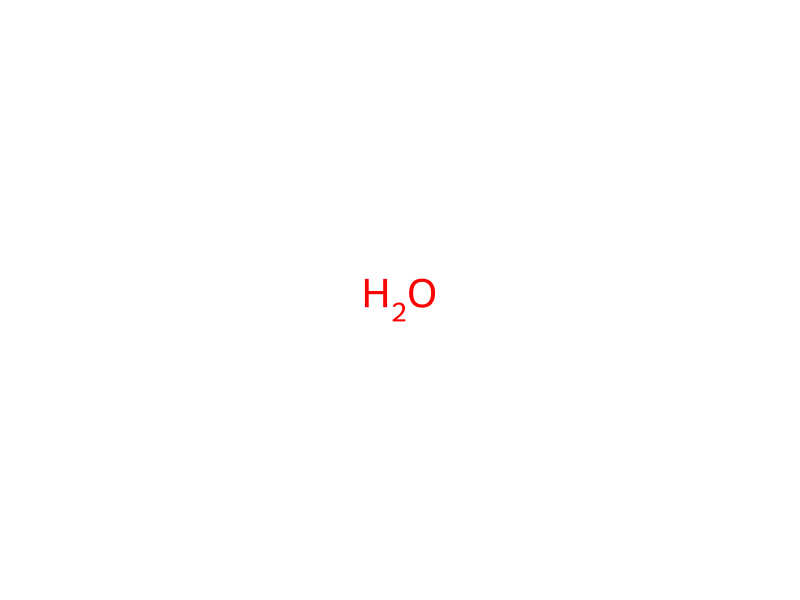
Water → 4-chloro-1-(beta-D-glucopyranosyl)indoline
Reaction equation

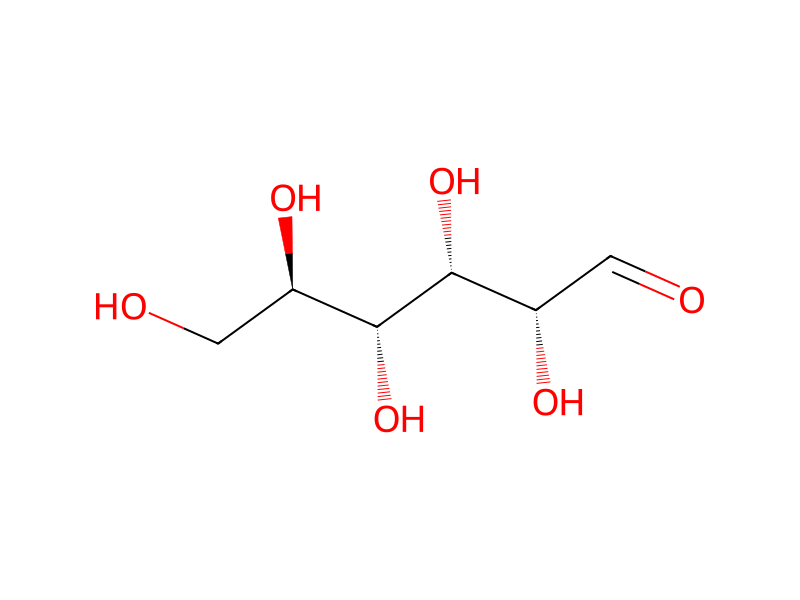
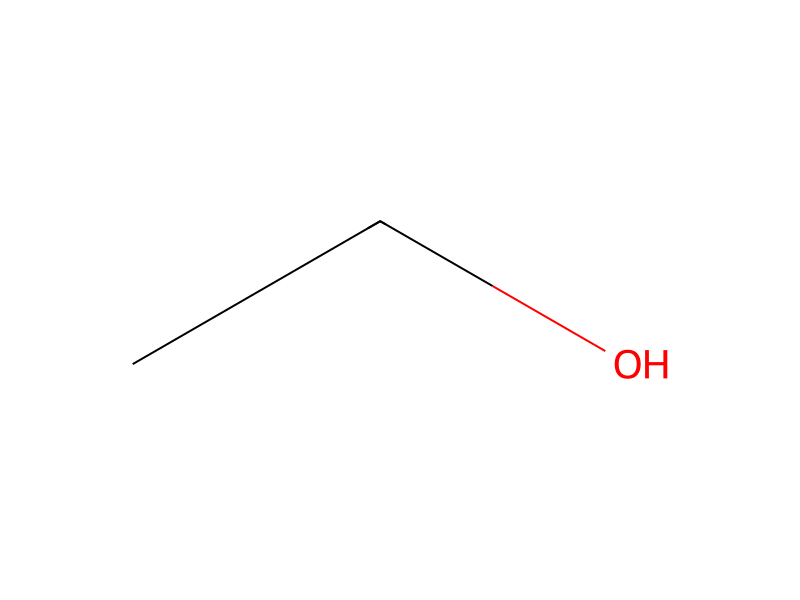
[Cl:1][C:2]1[CH:10]=[CH:9][CH:8]=[C:7]2[C:3]=1[CH2:4][CH2:5][NH:6]2.[O:11]=[CH:12][C@@H:13]([C@H:15]([C@@H:17]([C@@H:19]([CH2:21][OH:22])[OH:20])[OH:18])[OH:16])O.O>C(O)C>[Cl:1][C:2]1[CH:10]=[CH:9][CH:8]=[C:7]2[C:3]=1[CH2:4][CH2:5][N:6]2[C@@H:21]1[O:22][C@H:13]([CH2:12][OH:11])[C@@H:15]([OH:16])[C@H:17]([OH:18])[C@H:19]1[OH:20]Participants
Reactant 3

Product 1

Reagents, catalysts & solvents 1
Procedure
A mixture of 4-chloroindoline (2.88 g) and D-glucose (3.38 g) in ethyl alcohol (150 ml)-H2O (10 ml) was refluxed under argon atmosphere overnight. The solvent was evaporated under reduced pressure and the residue was purified by silica gel column chromatography (chloroform:methanol=100:0-88:12) to give 4-chloro-1-(β-D-glucopyranosyl)indoline (3.35 g) as a colorless foam. APCI-Mass m/Z 316/318 (M+H). 1H-NMR (DMSO-d6) δ 2.87-3.02 (m, 2H), 3.07-3.12 (m, 1H), 3.20-3.32 (m, 2H), 3.38-3.47 (m, 2H), 3.51-3.60 (m, 2H), 3.68-3.73 (m, 1H), 4.34-4.37 (m, 1H), 4.63 (d, J=8.3-Hz, 1H), 4.93 (d, J=5.1 Hz, 1H), 5.03 (d, J=4.0 Hz, 1H), 5.06 (d, J=4.5 Hz, 1H), 6.53 (d, J=8.0 Hz, 1H), 6.60 (d, J=8.0 Hz, 1H), 6.99 (t, J=7.9 Hz, 1H). (2) The above compound (3.3 g) was dissolved in 1,4-dioxane (150 ml), and thereto was added 2,3-dichloro-5,6-dicyano-1,4-benzoquinone (2.85 g). The mixture was stirred at room temperature for 12 hours. To the reaction mixture was added a saturated aqueous sodium hydrogen carbonate solution (300 ml), and the mixture was extracted with ethyl acetate 3 times. The combined organic layer was washed with a saturated aqueous sodium hydrogen carbonate solution and dried over magnesium sulfate. The insoluble materials were filtered off, and the filtrate was evaporated under reduced pressure. The residue was purified by silica gel column chromatography (chloroform:methanol=100:0-86:14) to give 4-chloro-1-(β-D-glucopyranosyl)indole (2.01 g) as pale brown crystals. APCI-Mass m/Z 314/316 (M+H). 1H-NMR (DMSO-d6) δ 3.24-3.50 (m, 4H), 3.68-3.74 (m, 2H), 4.54 (t, J=5.5 Hz, 1H), 5.11 (d, J=5.3 Hz, 1H), 5.20 (d, J=4.8 Hz, 1H), 5.28 (d, J=5.8 Hz, 1H), 5.44 (d, J=9.2 Hz, 1H), 6.51 (d, J=3.4 Hz, 1H), 7.11-7.16 (m, 2H), 7.57-7.58 (m, 2H). (3) The above compound (2.01 g) was suspended in dichloromethane (100 ml), and thereto were added successively acetic anhydride (4.24 ml), N,N-diisopropylethylamine (7.8 ml) and 4-(dimethylamino)pyridine (78 mg). After being stirred at room temperature for 30 minutes, the mixture was washed successively with an aqueous citric acid solution, water and a saturated aqueous sodium hydrogen carbonate solution. The organic layer was dried over magnesium sulfate. The insoluble materials were filtered off, and the filtrate was evaporated under reduced pressure. The residue was purified by crystallization from diethyl ether—hexane to give 4-chloro-1-(2,3,4,6-tetra-O-acetyl-β-D-glucopyranosyl)-indole (2.94 g) as colorless crystals. APCI-Mass m/Z499/501 (M+NH4) 1H-NMR (DMSO-d6) δ 1.65 (s, 3H), 1.97 (s, 3H), 1.99 (s, 3H), 2.04 (s, 3H), 4.08-4.16 (m, 2H), 4.28-4.32 (m, 1H), 5.26 (t, J=9.8 Hz, 1H), 5.53 (t, J=9.5 Hz, 1H), 5.62 (t, J=9.3 Hz, 1H), 6.23 (d, J=9.2 Hz, 1H), 6.56 (d, J=3.4 Hz, 1H), 7.16 (d, J=8.2 Hz, 1H), 7.21 (t, J=7.9 Hz, 1H), 7.61 (d, J=3.5 Hz, 1H), 7.67 (d, J=8.2 Hz, 1H). (4) The above compound was treated in a manner similar to Example 1-(4) to give 4-chloro-1-(2,3,4,6-tetra-O-acetyl-β-D-gluco-pyranosyl)indole-3-carboxaldehyde as a colorless powder. APCI-Mass m/Z 527/529 (M+NH4). 1H-NMR (DMSO-d6) δ 1.64 (s, 3H) 1.98 (s, 3H), 1.99 (s, 3H), 2.05 (s, 3H), 4.09-4.19 (m, 2H), 4.30 (m, 1H), 5.34 (t, J=9.8 Hz, 1H), 5.54 (t, J=9.5 Hz, 1H), 5.70 (t, J=9.3 Hz, 1H), 6.37 (d, J=9.0 Hz, 1H), 7.35-7.42 (m, 2H), 7.82 (d, J=7.5 Hz, 1H), 8.54 (s, 1H), 10.51 (s, 1H). (5) The above compound and 1-bromo-4-cyclopropylbenzene (see WO 96/07657) were treated in a manner similar to Example 1-(5) to give crude 4-chloro-1-(2,3,4,6-tetra-O-acetyl-β-D-gluco-pyranosyl)indol-3-yl 4-cyclopropylphenyl methanol, which was used in the subsequent step without further purification. (6) The above compound was treated in a manner similar to Example 1-(6) to give 4-chloro-3-(4-cyclopropylphenylmethyl)-1-(2,3,4,6-tetra-O-acetyl-β-D-glucopyranosyl)indole as a colorless solid. APCI-Mass m/Z 629/631 (M+NH4). 1H-NMR (DMSO-d6) δ 0.58-0.62 (m, 2H), 0.88-0.92 (m, 2H), 1.65 (s, 3H), 1.82-1.88 (m, 1H), 1.96 (s, 3H), 1.99 (s, 3H), 2.03 (s, 3H), 4.07-4.13 (m, 2H), 4.15 (ABq, J=16.2 Hz, 1H), 4.19 (ABq, J=16.2 Hz, 1H), 4.28 (m, 1H), 5.24 (t, J=9.6 Hz, 1H), 5.50 (t, J=9.3 Hz, 5.55 (t, J=9.2 Hz, 1H), 6.17 (d, J=8.7 Hz, 1H), 6.95 (d, J=8.0 Hz, 2H), 7.02 (d, J=8.0 Hz, 2H), 7.05 (d, J=7.7 Hz, 1H), 7.16 (t, J=7.9 Hz, 1H), 7.25 (s, 1H), 7.64 (d, J=8.3 Hz, 1H). (7) The above compound was treated in a manner similar to Example 1-(7) to give the titled compound, 4-chloro-3-(4-cyclopropyl-phenylmethyl)-1-(β-D-glucopyranosyl) indole as a colorless powder. APCI-Mass m/Z 444/446 (M+H), 461/463 (M+NH4). 1H-NMR (DMSO-d6) δ 0.59-0.62 (m, 2H), 0.87-0.92 (m, 2H), 1.82-1.89 (m, 1H), 3.20-3.48 (m, 4H), 3.60-3.70 (m, 2H), 4.21 (s, 2H), 4.54 (t, J=5.5 Hz, 1H), 5.10 (d, J=5.3 Hz, 1H), 5.17 (d, J=5.1 Hz, 1H), 5.21 (d, J=5.9 Hz, 1H), 5.39 (d, J=9.0 Hz, 1H), 6.96 (d, J=8.2 Hz, 2H), 7.02 (d, J=7.2 Hz, 1H), 7.09 (d, J=8.0 Hz, 2H), 7.09 (t, J=7.8 Hz, 1H), 7.22 (s, 1H), 7.53 (d, J=8.2 Hz, 1H).
Workup
- temperaturewas refluxed under argon atmosphere overnight
- customThe solvent was evaporated under reduced pressure
- customthe residue was purified by silica gel column chromatography (chloroform:methanol=100:0-88:12)
Sources & evidence
- ORD record
- ord-deda7c8fbc7149bf9dadaaaea4dfd0a5
- Source dataset
- uspto-grants-2010_12
- Patent number
- US07851617B2
Reaction notes
Loading…