Sodium Hydroxide → 4-Chloro-6-(1H-5-indolyloxy)-2-pyrimidinamine
Reaction equation

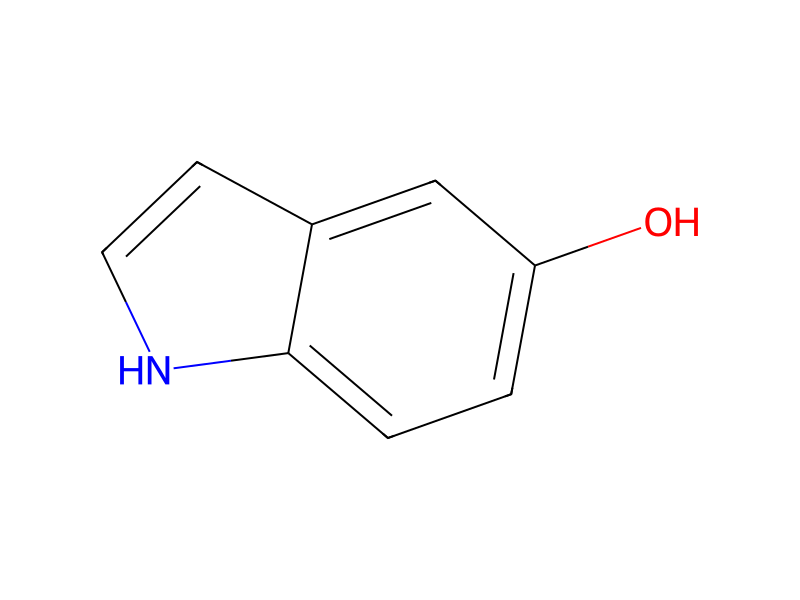
[NH2:1][C:2]1[N:7]=[C:6]([Cl:8])[CH:5]=[C:4](Cl)[N:3]=1.[OH:10][C:11]1[CH:12]=[C:13]2[C:17](=[CH:18][CH:19]=1)[NH:16][CH:15]=[CH:14]2.[OH-].[Na+].CCOC(C)=O.CCCCCC>CC(C)=O.O>[NH2:1][C:2]1[N:3]=[C:4]([O:10][C:11]2[CH:12]=[C:13]3[C:17](=[CH:18][CH:19]=2)[NH:16][CH:15]=[CH:14]3)[CH:5]=[C:6]([Cl:8])[N:7]=1Participants
7






Conditions
- Temperature
- 70 °C
Procedure
10 g (61 mMol) 2-amino-4,6-dichloro-pyrimidine and 8.1 g (61 mMol) 5-hydroxyindole are suspended in 250 ml acetone. Then 120 ml 1 N NaOH in water are added and the mixture is stirred at an oilbath temperature of 70° C. for 2 h. The reaction mixture is partially concentrated and the residue diluted with water. Extraction with 3 portions of EtOAc, washing the organic layers twice with water and brine, drying (Na2SO4), addition of 100 g SiO2 and concentration in vacuo gives a powder. This is put on top of a chromatography column (SiO2; EtOAc/hexane 3:7) and eluted with EtOAc/hexane 3:7. Crystallization from hexane gives the title compound: m.p.: 192° C.; MS: [M+1]+=261; HPLC: AtRet=12.4.
Workup
- concentrationThe reaction mixture is partially concentrated
- additionthe residue diluted with water
- extractionExtraction with 3 portions of EtOAc
- washwashing the organic layers twice with water and brine
- customdrying
- addition(Na2SO4), addition of 100 g SiO2 and concentration in vacuo
- customgives a powder
- washeluted with EtOAc/hexane 3:7
- customCrystallization from hexane
Sources & evidence
- ORD record
- ord-c5b770765eb7434e9e4b00bbbf28a74b
- Source dataset
- uspto-grants-2010_12
- Patent number
- US07855215B2
Reaction notes
Loading…