Sodium Carbonate → 2-(4-Fluorophenyl)thiophene
Reaction equation

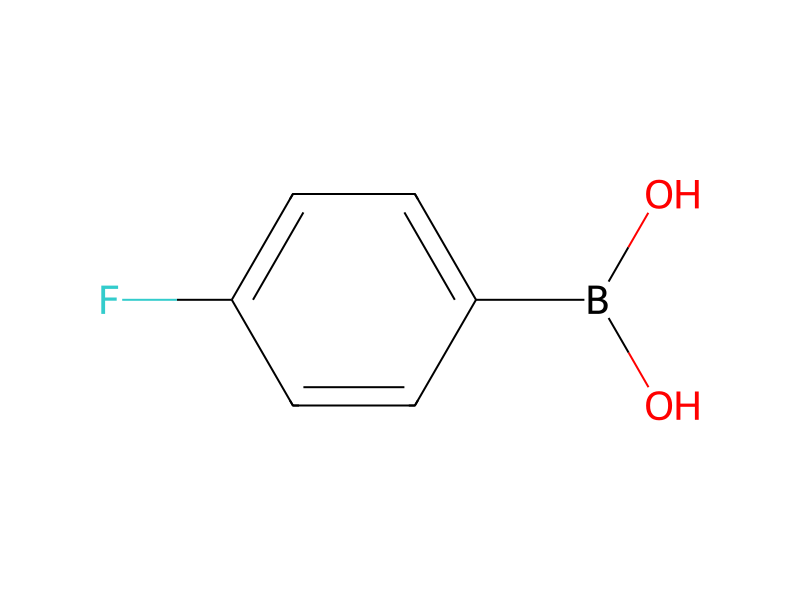
C(=O)([O-])[O-].[Na+].[Na+].[F:7][C:8]1[CH:13]=[CH:12][C:11](B(O)O)=[CH:10][CH:9]=1.Br[C:18]1[S:19][CH:20]=[CH:21][CH:22]=1>O.C(COC)OC.[Pd].C1(P(C2C=CC=CC=2)C2C=CC=CC=2)C=CC=CC=1.C1(P(C2C=CC=CC=2)C2C=CC=CC=2)C=CC=CC=1.C1(P(C2C=CC=CC=2)C2C=CC=CC=2)C=CC=CC=1.C1(P(C2C=CC=CC=2)C2C=CC=CC=2)C=CC=CC=1>[F:7][C:8]1[CH:13]=[CH:12][C:11]([C:18]2[S:19][CH:20]=[CH:21][CH:22]=2)=[CH:10][CH:9]=1Participants
7
Reactant 3


Product 1

Reagents, catalysts & solvents 3



Procedure
A solution of sodium carbonate (1.63 g) in H2O (7.65 ml), 4-fluorobenzeneboronic acid (1.03 g) and tetrakis(triphenylphosphine) palladium(0) (70.9 mg) were added successively to a solution of 2-bromothiophene (1.00 g) in dimethoxyethane (12.3 ml). The mixture was refluxed for 4 hours. The mixture was cooled to ambient temperature and partitioned between AcOEt and H2O. The organic layer was washed with 0.5N aqueous NaOH solution and saturated aqueous NaCl solution, dried over MgSO4 and concentrated in vacuo. The residue was purified by SiO2 column chromatography (eluent: n-hexane and then AcOEt in n-hexane 10%). The solvent was evaporated in vacuo to give 1.05 g of 2-(4-fluorophenyl)thiophene as a white solid.
Workup
- temperatureThe mixture was refluxed for 4 hours
- custompartitioned between AcOEt and H2O
- washThe organic layer was washed with 0.5N aqueous NaOH solution and saturated aqueous NaCl solution
- dry with materialdried over MgSO4
- concentrationconcentrated in vacuo
- customThe residue was purified by SiO2 column chromatography (eluent
- customThe solvent was evaporated in vacuo
Sources & evidence
- ORD record
- ord-87852ba9af824dd18457fc37a6b0979f
- Source dataset
- uspto-grants-2001_12
- Patent number
- US06333324B1
Reaction notes
Loading…