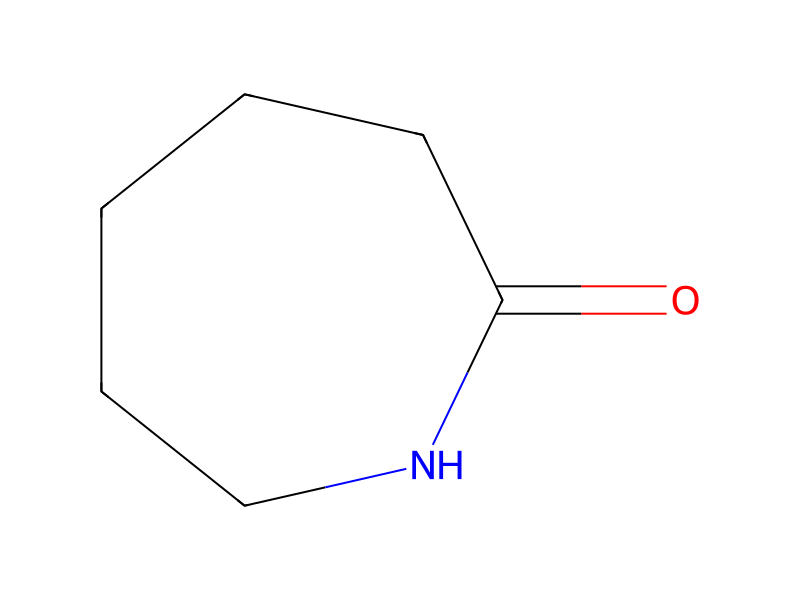
Ammonia → Caprolactam
Reaction equation

[CH:1]([CH2:3][CH2:4][CH2:5][CH2:6][C:7]([O:9][CH3:10])=[O:8])=[O:2].[NH3:11].[H][H]>CO>[NH2:11][CH2:1][CH2:3][CH2:4][CH2:5][CH2:6][C:7]([O:9][CH3:10])=[O:8].[C:1]1(=[O:2])[NH:11][CH2:7][CH2:6][CH2:5][CH2:4][CH2:3]1Participants
Reactant 3



Product 2

Reagents, catalysts & solvents 1

Procedure
Such a process is described in U.S. Pat. No. 4,731,445. This publication describes a process in which first methyl 5-formylvalerate is contacted with ammonia and hydrogen in the presence of methanol as solvent and a hydrogenation catalyst. In this step methyl 6-aminocaproate and a small amount of ε-caprolactam is obtained. In a second step, the excess ammonia and hydrogen are removed from the reaction mixture. In a third step, the methyl 6-aminocaproate is reacted with water in the presence of a small amount (0.1 to 2 wt. %) of ammonia at a temperature of 50 to 250 ° C. The released methanol is simultaneously removed. Example 1 of U.S. Pat. No. 4,731,445 discloses the reaction of methyl 6-aminocaproate with water in the presence of an almost negligible amount of ammonia at a temperature of about 100° C. The resulting aqueous mixture, which mixture contains 6-aminocaproic acid and small amounts of 6-minocaproamide and ε-caprolactam, is heated to a emperature of 330° C. In this step the 6-aminocaproic acid and 6-aminocaproamide reacts by cyclization to ε-caprolactam.
Sources & evidence
- ORD record
- ord-0c4f98ac782a4c91b1e9575b625b646a
- Source dataset
- uspto-grants-2001_12
- Patent number
- US06333412B1
Reaction notes
Loading…