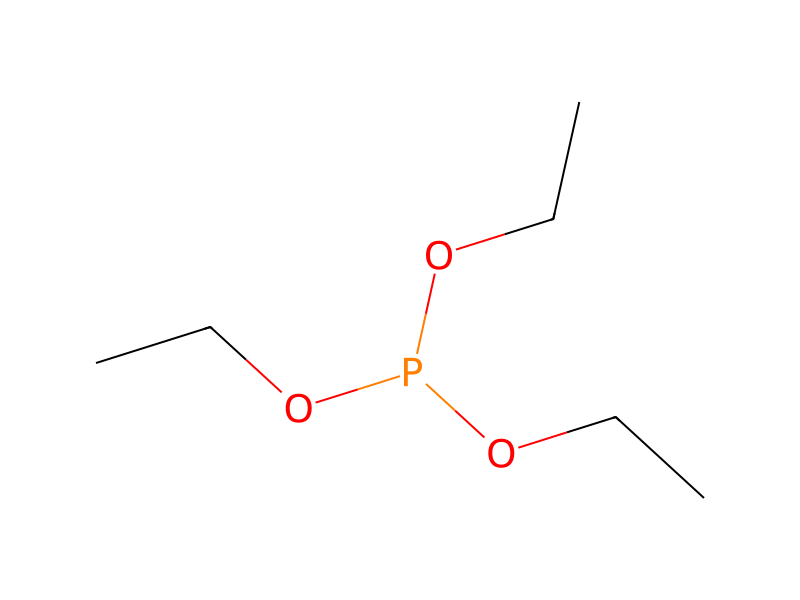
Triethyl phosphite → CBZO
Reaction equation

[N+:1]([C:4]1[CH:9]=[CH:8][CH:7]=[CH:6][C:5]=1[C:10]1[C:15]2[O:16][C:17]3[CH:22]=[CH:21][CH:20]=[CH:19][C:18]=3[C:14]=2[CH:13]=[CH:12][CH:11]=1)([O-])=O.P(OCC)(OCC)OCC>ClC1C=CC=CC=1Cl>[CH:22]1[C:17]2[O:16][C:15]3[C:10]4[C:5]5[C:4]([NH:1][C:11]=4[CH:12]=[CH:13][C:14]=3[C:18]=2[CH:19]=[CH:20][CH:21]=1)=[CH:9][CH:8]=[CH:7][CH:6]=5Participants
4
Reactant 2

Product 1

Reagents, catalysts & solvents 1

Procedure
20 g of 4-(2-nitrophenyl)dibenzofuran (69 mmol) and 48 ml of triethyl phosphite (276 mmol) are heated at the boil in 800 ml of 1,2-dichlorobenzene under a protective-gas atmosphere for 48 h. After this time, the remaining triethyl phosphite and the 1,2-dichlorobenzene are removed by distillation. The residue which remains is recrystallised from heptane/ethyl acetate. The yield is 13 g (45 mmol, 65%).
Workup
- customAfter this time, the remaining triethyl phosphite and the 1,2-dichlorobenzene are removed by distillation
- customThe residue which remains is recrystallised from heptane/ethyl acetate
Sources & evidence
- ORD record
- ord-1983fe9222d5478da712ec9662ef704c
- Source dataset
- uspto-grants-2015_09
- Patent number
- US09126970B2
Reaction notes
Loading…