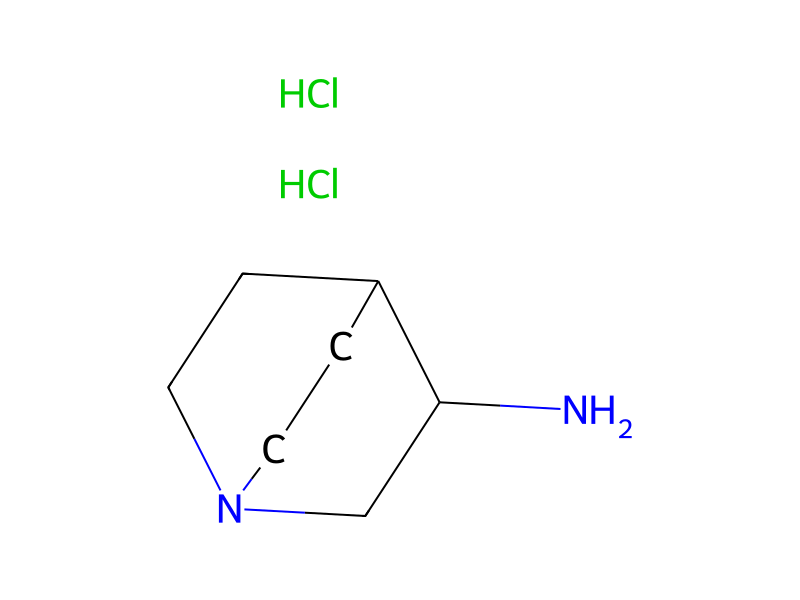
Quinuclidine, 3-amino-, dihydrochloride → N-(1-Azabicyclo[2.2.2]oct-3-yl)-7-quinolinecarboxamide hydrochloride
Reaction equation

[N:1]1[C:10]2[C:5](=[CH:6][CH:7]=[C:8]([C:11]([OH:13])=O)[CH:9]=2)[CH:4]=[CH:3][CH:2]=1.[ClH:14].Cl.[NH2:16][CH:17]1[CH:22]2[CH2:23][CH2:24][N:19]([CH2:20][CH2:21]2)[CH2:18]1>>[ClH:14].[N:19]12[CH2:24][CH2:23][CH:22]([CH2:21][CH2:20]1)[CH:17]([NH:16][C:11]([C:8]1[CH:9]=[C:10]3[C:5]([CH:4]=[CH:3][CH:2]=[N:1]3)=[CH:6][CH:7]=1)=[O:13])[CH2:18]2Participants
3


Procedure
Prepared in analogy to the method for Example 1 starting from 183 mg of quinoline-7-carboxylic acid (Seibert et al. J. Am. Chem. Soc. 1946, 68, 2721) and 200 mg of 3-aminoquinuclidine dihydrochloride. 227 mg (71% yield) of the hydro-chloride were obtained.
Sources & evidence
- ORD record
- ord-d1987358e1c04a7b9234d9af2ac71c09
- Source dataset
- uspto-grants-2015_09
- Patent number
- US09139579B2
Reaction notes
Loading…