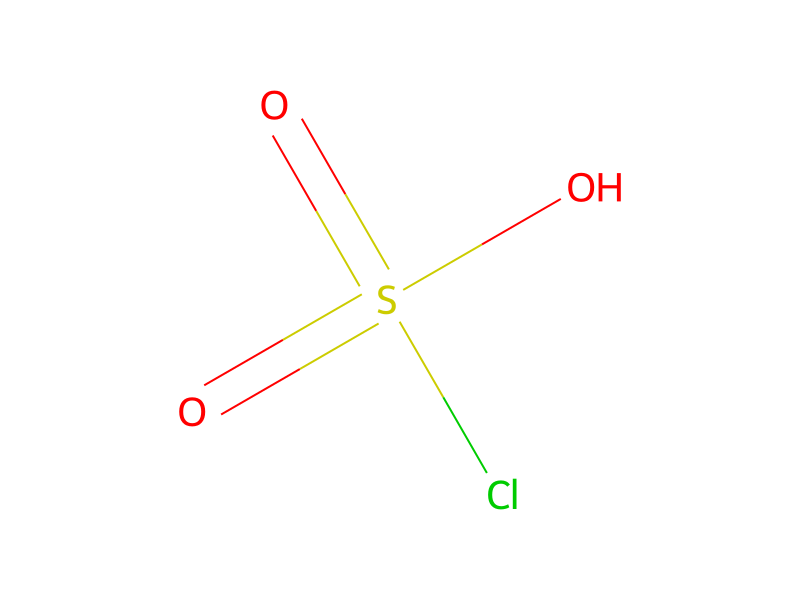
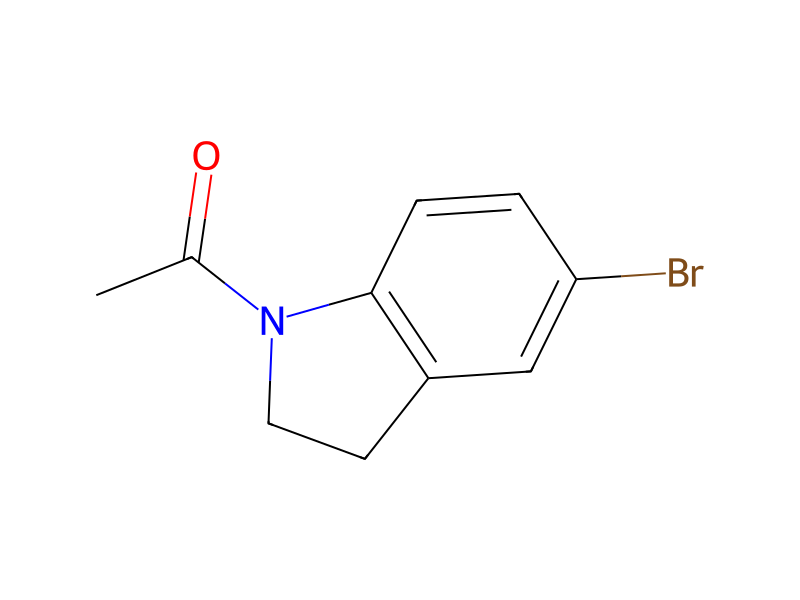
Chlorosulfonic acid → 1-acetyl-5-bromo-2,3-dihydro-1H-indole-6-sulfonyl chloride
Reaction equation

[Br:1][C:2]1[CH:3]=[C:4]2[C:8](=[CH:9][CH:10]=1)[N:7]([C:11](=[O:13])[CH3:12])[CH2:6][CH2:5]2.[Cl:14][S:15](O)(=[O:17])=[O:16]>>[Br:1][C:2]1[CH:3]=[C:4]2[C:8](=[CH:9][C:10]=1[S:15]([Cl:14])(=[O:17])=[O:16])[N:7]([C:11](=[O:13])[CH3:12])[CH2:6][CH2:5]2Participants
3

Conditions
- Temperature
- 0 °C
Procedure
To 5-bromo-N-acetylindoline 122.86 g (0.51 mol) cooled in an ice bath was added chlorosulfonic acid, 116.52 g (2.6 moles) very cautiously. The mixture was stirred for about 30 minutes at 0° C. and then allowed to warm to room temperature. The mixture was then heated slowly to about 70°-90° C. overnight. After cooling, the cold solution was slowly added to ice and the solids collected by suction filtration, washed several times with water and allowed to dry overnight. The product was recrystallized from chloroform to give 72.5 g (42% by weight yield) of 5-bromo-6-chlorosulfonyl-N-acetylindoline.
Workup
- temperatureto warm to room temperature
- temperatureThe mixture was then heated slowly to about 70°-90° C. overnight
- temperatureAfter cooling
- additionthe cold solution was slowly added to ice
- filtrationthe solids collected by suction filtration
- washwashed several times with water
- customto dry overnight
- customThe product was recrystallized from chloroform
Sources & evidence
- ORD record
- ord-eb737f28619e4bac81466e0164103389
- Source dataset
- uspto-grants-1986_10
- Patent number
- US04615966
Reaction notes
Loading…