Pyridine → 2-Bromo-1,1,1-triethoxypropane
Reaction equation

[C:1]([O:10][CH2:11][CH3:12])([O:7][CH2:8][CH3:9])([O:4][CH2:5][CH3:6])[CH2:2][CH3:3].N1C=CC=CC=1.[Br:19]Br>C(Cl)(Cl)(Cl)Cl>[CH2:11]([O:10][C:1]([O:4][CH2:5][CH3:6])([O:7][CH2:8][CH3:9])[CH:2]([Br:19])[CH3:3])[CH3:12]Participants
5
Reactant 3


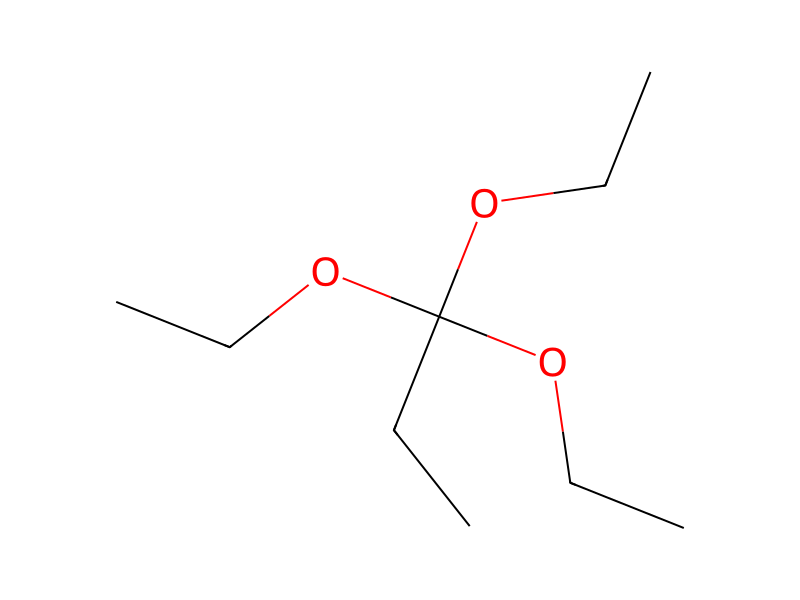
Product 1

Reagents, catalysts & solvents 1

Procedure
A solution of 176 g (1 mole) of triethyl orthopropionate and 96 g (1.2 moles) of pyridine in 1 l of carbon tetrachloride was placed in a 2 l flask and 160 g (1 mole) of bromine was slowly added over two hours to the solution under ice-cooling. The resultant reaction mixture was allowed to stand at room temperature for one day to form a precipitate, which was then filtered off. The filtrate was concentrated by evaporation of the solvent and the residue was subjected to distillation under reduced pressure to afford 206 g (81%) of 1,1,1-triethoxy-2-bromopropane with a boiling point of 85° C./13 mmHg.
Workup
- temperaturecooling
- customThe resultant reaction mixture
- customto form a precipitate, which
- filtrationwas then filtered off
- concentrationThe filtrate was concentrated by evaporation of the solvent
- distillationthe residue was subjected to distillation under reduced pressure
Sources & evidence
- ORD record
- ord-9fa1efd560ff4003a47342236a8d546b
- Source dataset
- uspto-grants-1984_01
- Patent number
- US04425473
Reaction notes
Loading…