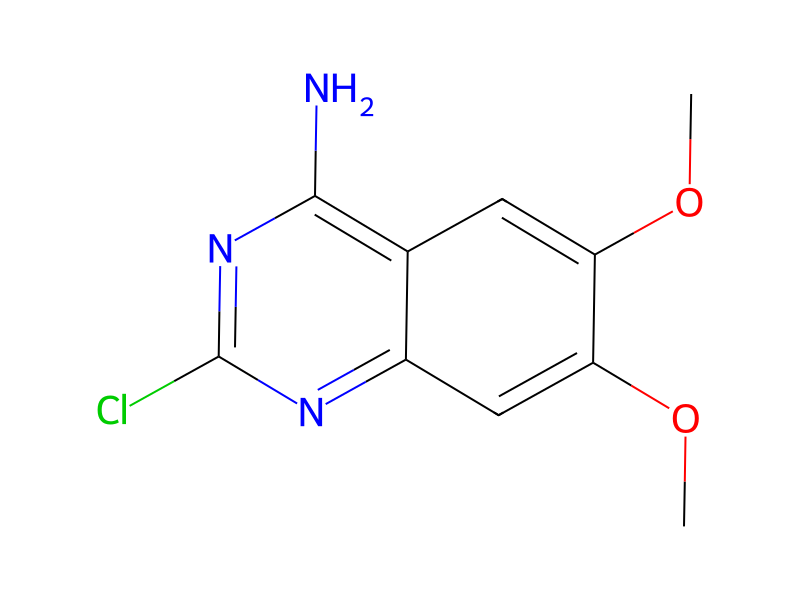
2-Chloro-6,7-dimethoxy-4-quinazolinamine → HCID 20473808, compound
Reaction equation

[NH2:1][C:2]1[C:11]2[C:6](=[CH:7][C:8]([O:14][CH3:15])=[C:9]([O:12][CH3:13])[CH:10]=2)[N:5]=[C:4]([Cl:16])[N:3]=1.[C:17]([N:22]1[CH2:27][CH2:26][NH:25][CH2:24][CH2:23]1)(=[O:21])/[CH:18]=[CH:19]/[CH3:20]>C(O)CC(C)C>[OH2:12].[ClH:16].[NH2:1][C:2]1[C:11]2[C:6](=[CH:7][C:8]([O:14][CH3:15])=[C:9]([O:12][CH3:13])[CH:10]=2)[N:5]=[C:4]([N:25]2[CH2:26][CH2:27][N:22]([C:17](=[O:21])/[CH:18]=[CH:19]/[CH3:20])[CH2:23][CH2:24]2)[N:3]=1Participants
4
Reactant 2

Product 1

Reagents, catalysts & solvents 1

Procedure
To 80 ml of isopentanol were added 4.55 g of 4-amino-2-chloro-6,7-dimethoxyquinazoline and 3.4 g of 1-crotonoylpiperazine; the resulting mixture was then refluxed for 1.5 hours. At the end of this time, the hot reaction mixture was filtered. The filtrate was cooled and the crystals which resulted were collected by filtration and then recrystallized from ethanol to give 3.52 g of the desired hydrochloride hydrate of Compound No. 1 in the form of colourless crystals melting at 255°-256° C. (with decomposition):
Workup
- temperaturethe resulting mixture was then refluxed for 1.5 hours
- filtrationAt the end of this time, the hot reaction mixture was filtered
- temperatureThe filtrate was cooled
- customthe crystals which resulted
- filtrationwere collected by filtration
- customrecrystallized from ethanol
Sources & evidence
- ORD record
- ord-57021342419c40b6857ab907e9de6161
- Source dataset
- uspto-grants-1984_01
- Patent number
- US04426382
Reaction notes
Loading…