Water → 3-(Tetradecyloxy)propan-1-ol
Reaction equation

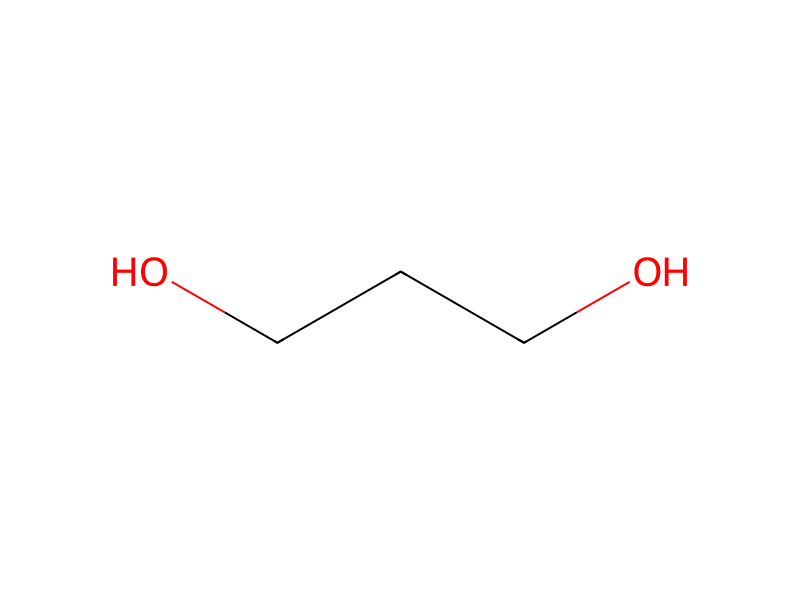
[CH2:1]([OH:5])[CH2:2][CH2:3][OH:4].[CH2:6](Br)[CH2:7][CH2:8][CH2:9][CH2:10][CH2:11][CH2:12][CH2:13][CH2:14][CH2:15][CH2:16][CH2:17][CH2:18][CH3:19].[OH-].[K+].O>CS(C)=O.O1CCCC1>[CH2:19]([O:4][CH2:3][CH2:2][CH2:1][OH:5])[CH2:18][CH2:17][CH2:16][CH2:15][CH2:14][CH2:13][CH2:12][CH2:11][CH2:10][CH2:9][CH2:8][CH2:7][CH3:6]Participants
Reactant 4



Product 1

Reagents, catalysts & solvents 1

Procedure
In 70 ml of a mixture of dimethylsulfoxide-tetrahydrofuran (1:1) are dissolved 12.3 g of trimethylene glycol and 15 g of tetradecyl bromide. To the solution is added 12 g of powdery potassium hydroxide. The mixture is vigorously stirred for one hour at a room temperature, which is refluxed under heating for two hours. The reaction mixture is poured into 400 ml of cold water, which is neutralized and subjected to extraction with ethyl acetate, then washed with water and dried. The resultant is concentrated to dryness, and the residue is dissolved in methanol when hot. Cooling of the solution gives precipitation of crystals, which are removed by filtration. The filtrate is refined by means of chromatography employing silica-gel (eluent: chloroform) to give 5.1 g of the end-product.
Workup
- temperaturewhich is refluxed
- temperatureunder heating for two hours
- extractionsubjected to extraction with ethyl acetate
- washwashed with water
- customdried
- concentrationThe resultant is concentrated to dryness
- dissolutionthe residue is dissolved in methanol when hot
- temperatureCooling of the solution
- customgives
- customprecipitation of crystals, which
- customare removed by filtration
Sources & evidence
- ORD record
- ord-f3c79f0c2ea14f1d9716cde923ae6315
- Source dataset
- uspto-grants-1984_01
- Patent number
- US04426525
Reaction notes
Loading…