5-Indanecarboxaldehyde → Methyl 4-(indan-5-ylamino)-5-methylthiothiophene-2-carboxylate
Reaction equation
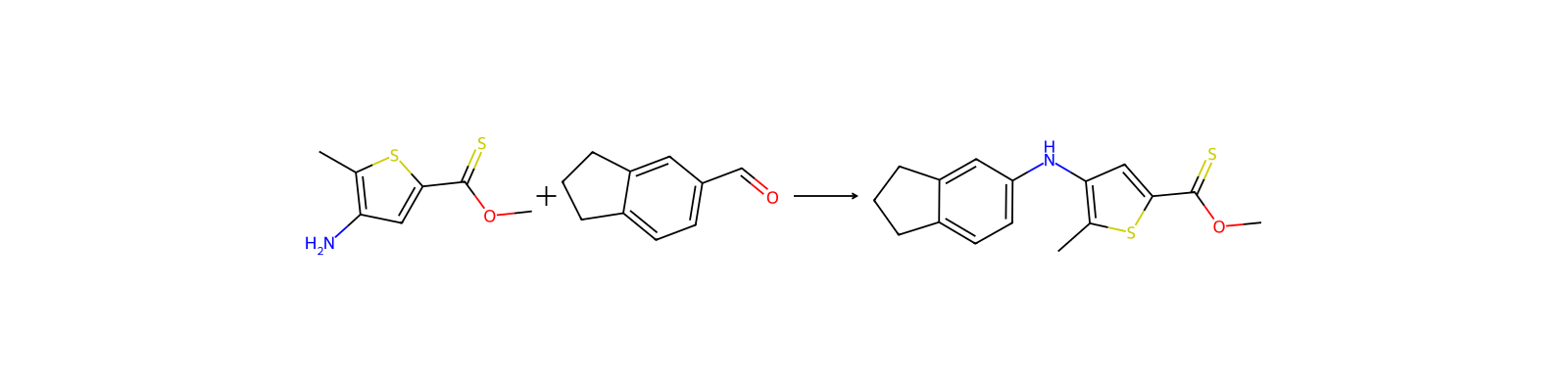
[NH2:1][C:2]1[CH:3]=[C:4]([C:8]([O:10][CH3:11])=[S:9])[S:5][C:6]=1[CH3:7].[CH2:12]1[C:20]2[C:15](=[CH:16][C:17](C=O)=[CH:18][CH:19]=2)[CH2:14][CH2:13]1>>[CH2:12]1[C:20]2[C:15](=[CH:16][C:17]([NH:1][C:2]3[CH:3]=[C:4]([C:8]([O:10][CH3:11])=[S:9])[S:5][C:6]=3[CH3:7])=[CH:18][CH:19]=2)[CH2:14][CH2:13]1Participants
3


Procedure
Using the procedure described in Example 220, step (a), 60 mg (0.29 mmol) of methyl 4-amino-5-methylthiothiophene-2-carboxylate, 42.3 mg (0.29 mmol) of 5-indancarboxaldehyde, and 135 mg (2.2 equiv, 0.63 mmol) of NaHB(OAc)3 were allowed to react to give methyl 4-(indan-5-ylamino)-5-methylthiothiophene-2-carboxylate. Mass spectrum (ESI, m/z): Calcd. for C17H19NO2S2, 334.09 (M+H), found 332.3 (imine), 333.4.
Workup
- customto react
Sources & evidence
- ORD record
- ord-f060671ec0bf4771b6f9648f2327acd0
- Source dataset
- uspto-grants-2002_12
- Patent number
- US06492403B1
Reaction notes
Loading…