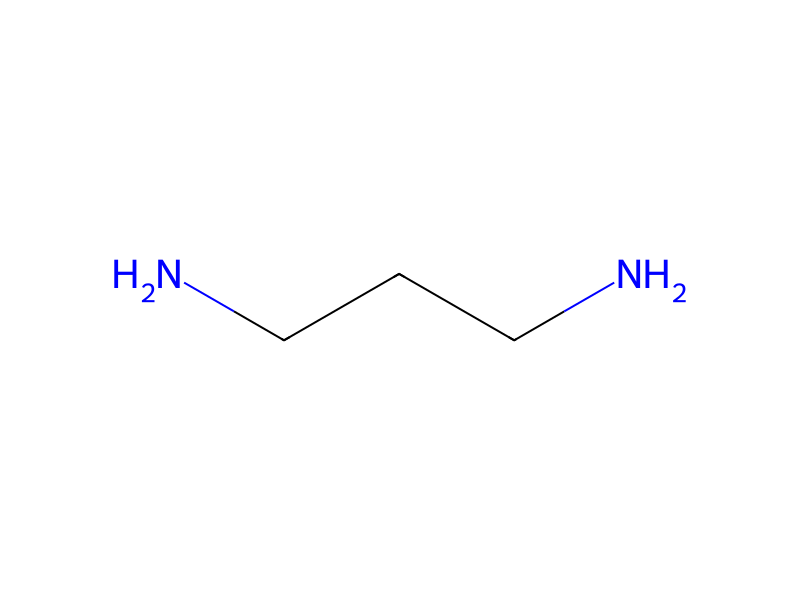
1,3-Propanediamine → HCID 18372212, compound
Reaction equation

[NH2:1][CH2:2][CH2:3][CH2:4][NH2:5].[Cl:6][C:7]1[CH:8]=[C:9]([S:14](Cl)(=[O:16])=[O:15])[CH:10]=[C:11]([Cl:13])[CH:12]=1>O1CCOCC1>[NH2:1][CH2:2][CH2:3][CH2:4][NH:5][S:14]([C:9]1[CH:8]=[C:7]([Cl:6])[CH:12]=[C:11]([Cl:13])[CH:10]=1)(=[O:16])=[O:15]Participants
Reactant 2

Product 1

Reagents, catalysts & solvents 1

Procedure
1,3-Diaminopropane (6 g, 81.5 mmol) was dissolved in 45 ml of 1,4-dioxane, and at 15-20° C. a solution of 3,5-dichlorobenzenesulfonyl chloride (2 g, 8.15 mmol) in 5 ml of 1,4-dioxane was slowly added over 3 hours under stirring. Stirring was continued at RT. After 30 hours the formed precipitate was filtered off and the filtrate concentrated in vacuo. The residue was distributed between ethyl acetate and water. The organic layer was separated, dried with magnesium sulfate, filtered, and concentrated in vacuo to yield 2.0 g of crude material. 750 mg of this material was purified by HPLC to yield 675 mg of the title compound as TFA salt (MS=283.0 (M+H)+). 200 mg of this product was dissolved in ethyl acetate and treated with 5 ml of diluted potassium carbonate solution. The organic layer was separated, dried, filtered, and concentrated in vacuo to yield the TFA free title amine.
Workup
- stirringStirring
- customwas continued at RT
- filtrationAfter 30 hours the formed precipitate was filtered off
- concentrationthe filtrate concentrated in vacuo
- customThe organic layer was separated
- dry with materialdried with magnesium sulfate
- filtrationfiltered
- concentrationconcentrated in vacuo
- customto yield 2.0 g of crude material
- custom750 mg of this material was purified by HPLC
Sources & evidence
- ORD record
- ord-6da877acf9344d3a9e2ec19406ce3da7
- Source dataset
- uspto-grants-2002_12
- Patent number
- US06500803B1
Reaction notes
Loading…