Potassium Hydroxide → HCID 2907651, compound
Reaction equation

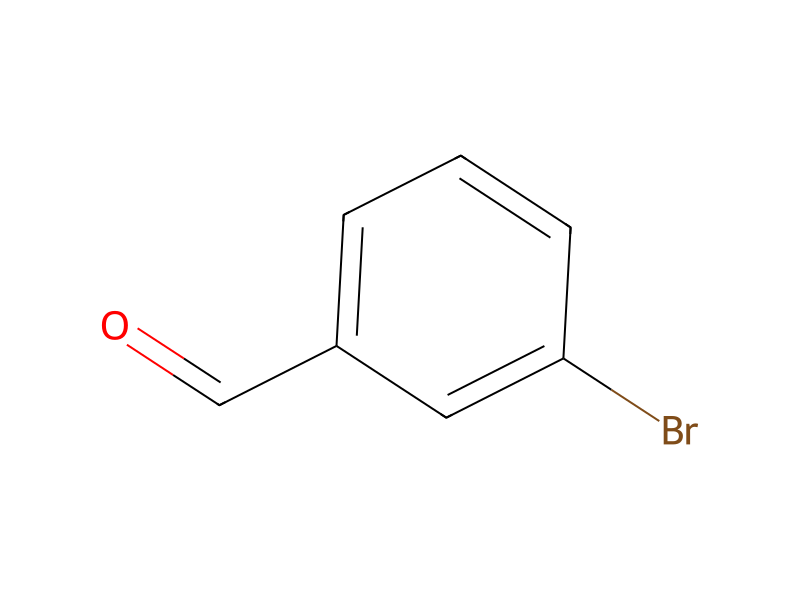
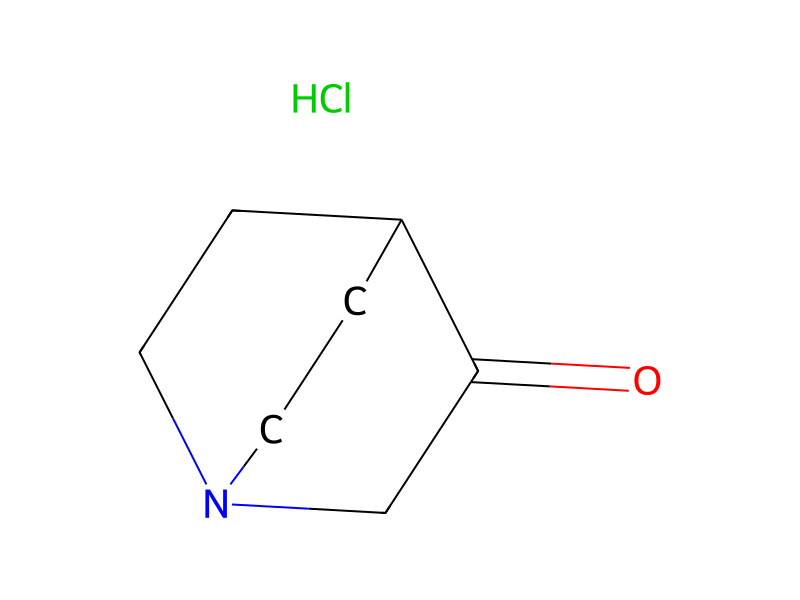
[Br:1][C:2]1[CH:3]=[C:4]([CH:7]=[CH:8][CH:9]=1)[CH:5]=O.Cl.[N:11]12[CH2:18][CH2:17][CH:14]([CH2:15][CH2:16]1)[C:13](=[O:19])[CH2:12]2.[OH-].[K+]>CO>[Br:1][C:2]1[CH:3]=[C:4]([CH:5]=[C:12]2[C:13](=[O:19])[CH:14]3[CH2:17][CH2:18][N:11]2[CH2:16][CH2:15]3)[CH:7]=[CH:8][CH:9]=1Participants
Reactant 3

Product 1

Reagents, catalysts & solvents 1

Procedure
The manner in which 2-[(2-, 3-, and 4-substituted phenyl)methyl]-1-azabicyclo[2.2.2]octanes are synthesized can vary. For example, in one method, 3-bromobenzaldehyde can be subjected to an aldol reaction with 3-quinuclidinone hydrochloride (commercially available from Aldrich Chemical Company) using potassium hydroxide in methanol to give 2-[(3-bromophenyl)methylene]-1-azabicyclo[2.2.2]octan-3-one. The latter unsaturated ketone can be reduced by hydrogenation using palladium over charcaol to give 2-[(3-bromophenyl)methyl]-1-azabicyclo[2.2.2]octan-3-one. Depending upon the choice of hydrogenation catalyst, it may be necessary to use suitable inhibitors to suppress dihologenation. For suitable catalysts and inhibitors, see Rylander, Catalytic Hydrogenation in Organic Synthesis, pp. 125-126 (1979). The resulting ketone can be reduced under Wolff-Kishner conditions with hydrazine and base (or under modified Wolff-Kishner conditions with tosylhydrazine and sodium cyanoborohydride) to yield 2-[(3-bromophenyl)methyl]-1-azabicyclo[2.2.2]octane. Methods similar to those described by A. D. Yanina et al., Khim.-Farm. Zh. 21(7):808-811 (1987) can be used. The isomeric compounds, 2-[(2-bromophenyl)methyl]-1-azabicyclo[2.2.2]octane and 2-[(4-bromophenyl)methyl]-1-azabicyclo[2.2.2]octane can be prepared in a similar manner by replacing 3-bromobenzaldehyde with 2-bromobenzaldehyde and 4-bromobenzaldehyde, respectively in the above synthetic approach. Alternatively, 2-[(3-bromophenyl)methyl]-1-azabicyclo[2.2.2]octane can be prepared form the previously described 2-[(3-aminophenyl)methyl]-1-azabicyclo[2.2.2]octane by conversion to the intermediate diazonium salt compound using sodium nitrite and acid at 0° C., followed by treatment with cuprous bromide under Sandmeyer reaction conditions. In a similar manner, 2-[(2-bromophenyl)methyl]-1-azabicyclo[2.2.2]octane and 2-[(4-bromophenyl)methyl]-1-azabicyclo[2.2.2]octane can be prepared from the corresponding amino compounds.
Sources & evidence
- ORD record
- ord-c20c72ba594643efb8e5afc6b450d40c
- Source dataset
- uspto-grants-2002_08
- Patent number
- US06432975B1
Reaction notes
Loading…