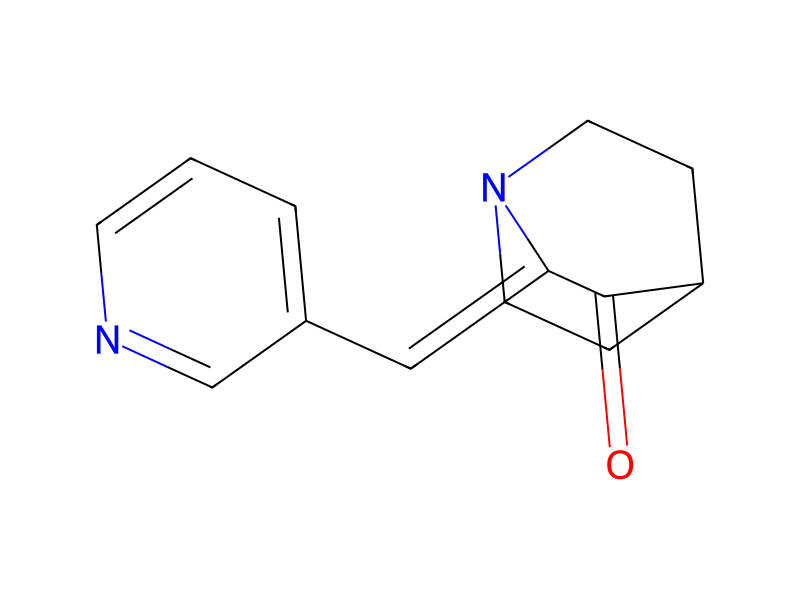
2-(Pyridin-3-ylmethylidene)-1-azabicyclo[2.2.2]octan-3-one → 2-(3-Pyridinylmethyl)-3-quinuclidinol
Reaction equation

[N:1]1[CH:6]=[CH:5][CH:4]=[C:3]([CH:7]=[C:8]2[C:13](=[O:14])[CH:12]3[CH2:15][CH2:16][N:9]2[CH2:10][CH2:11]3)[CH:2]=1>[Ni].CO>[N:1]1[CH:6]=[CH:5][CH:4]=[C:3]([CH2:7][CH:8]2[CH:13]([OH:14])[CH:12]3[CH2:11][CH2:10][N:9]2[CH2:16][CH2:15]3)[CH:2]=1Participants
Reactant 1
Product 1

Reagents, catalysts & solvents 2


Procedure
Quinuclidin-3-one hydrochloride (4.6 g, 28.3 mmol) and powdered anhydrous potassium hydroxide (2.1 g, 37.2 mmol) were dissolved in methanol (25 ml) and stirred for 15 mins. Pyridine-3-carboxaldehyde (3.2 g, 29.5 mmol) was then added in one portion and the mixture was stirred for an additional 20 hrs. The reaction mixture was then diluted with 40 ml water and cooled to 0° C. yielding 2-((3-pyridyl)methylene)-1-azabicyclo[2.2.2]octan-3-one as a yellow precipitate, which was collected, washed with distilled water and dried under vacuum (5.16 g, 81.4%). 2-((3-Pyridyl)methylene)-1-azabicyclo[2.2.2]octan-3-one (1.0 g, 4.7 mmol) was combined with 50 ml methanol in a hydrogenation vessel, then wet Raney nickel (5 grams) was added in one portion. Hydrogenation (50 psig) was carried out for 12 hrs., after which time the slurry was carefully filtered through a pad of Celite filter aid. Evaporation of solvent gave 2-((3-pyridyl)methyl)-1-azabicyclo[2.2.2]octan-3-ol as a light yellow oil, which dissolved in ethanol/HCl give a white crystalline solid upon cooling (0.78 g 77%).
Workup
- customwas collected
- washwashed with distilled water
- customdried under vacuum (5.16 g, 81.4%)
- filtration, after which time the slurry was carefully filtered through a pad of Celite
- filtrationfilter aid
- customEvaporation of solvent
Sources & evidence
- ORD record
- ord-b71360d5f20e4cf3bc34c276e4feb0de
- Source dataset
- uspto-grants-2002_08
- Patent number
- US06432975B1
Reaction notes
Loading…