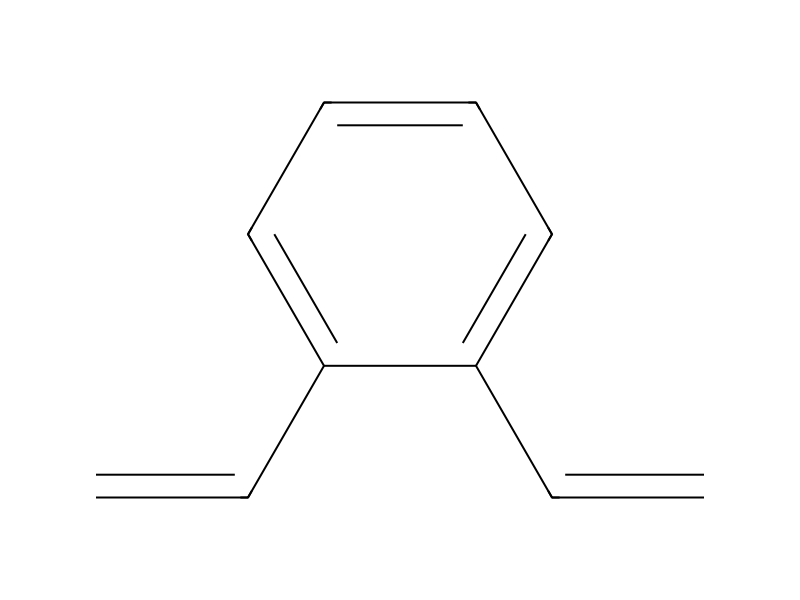
Benzoyl Peroxide → Divinylbenzene-styrene
Reaction equation

[CH2:1]=[CH:2][C:3]1[CH:8]=[CH:7][CH:6]=[CH:5][CH:4]=1.[CH:9]([C:11]1[CH:16]=[CH:15][CH:14]=[CH:13][C:12]=1[CH:17]=[CH2:18])=[CH2:10].C(OOC(=O)C1C=CC=CC=1)(=O)C1C=CC=CC=1>>[CH:9]([C:11]1[CH:16]=[CH:15][CH:14]=[CH:13][C:12]=1[CH:17]=[CH2:18])=[CH2:10].[CH2:1]=[CH:2][C:3]1[CH:8]=[CH:7][CH:6]=[CH:5][CH:4]=1Participants



Procedure
A 2000 ml four - necked reaction flask equipped with a stirrer, condenser, thermometer, and nitrogen inlet was evacuated and charged with nitrogen. 900 ml deionized water, 7.2 grams of gum arabic and 7.2 grams of a lignosulfonate available from the American Can Co. under the trademark Marasperse N-22, were charged into the reaction flask. The mixture was stirred and heated in an oil bath at about 60 degrees Celsius until the dispersants dissolved to form a phase. To this mixture was added a freshly prepared solution of 90.8 grams of styrene (99.8% purity), 45.2 grams commercial divinylbenzene (55.6% divinylbenzene, 42.3% ethylvinylbenzene), 2.5 grams benzoyl peroxide (70% active ingredient and 30% water), and 146.0 grams of mineral oil. The initiator benzoyl peroxide was dissolved in monomer before mineral oil is added because mineral oil does not readily dissolve benzoyl peroxide unless benzoyl peroxide is dissolved in a monomer. The phase and solution were agitated by a mechanical stirrer whose stirring rate was adjusted to obtain a plurality of droplets having a droplet diameter in the range of 5 to 80 microns. The gum arabic and lignosulfonate serve to stabilize the plurality of droplets. The reaction mixture was then heated to about 95 degrees Celsius and and maintained at that temperature for about 18 to 20 hours at the adjusted stirring rate to form porous beads of styrene divinylbenzene having a network of pores with mineral oil held within the network of pores. The mixture was then cooled, the porous polymeric beads were removed from the reaction flask by filtration, washed initially three times with one liter of water to remove gum arabic and lignosulfonate, followed by three washes of 1 liter of methanol to remove residual or unreacted monomer. The purified product was then dried to remove methanol and the resulting polymeric delivery vehicles were white and opaque indicating their macroporosity.
Workup
- customA 2000 ml four - necked reaction flask equipped with a stirrer, condenser
- customthermometer, and nitrogen inlet was evacuated
- additioncharged with nitrogen
- additionunder the trademark Marasperse N-22, were charged into the reaction flask
- temperatureheated in an oil bath at about 60 degrees Celsius until the dispersants
- dissolutiondissolved
- customto form a phase
- additionis added because mineral oil
- dissolutionis dissolved in a monomer
- stirringThe phase and solution were agitated by a mechanical stirrer whose
- stirringstirring rate
- customto obtain a plurality of droplets
- temperatureThe reaction mixture was then heated to about 95 degrees Celsius
- temperaturemaintained at that temperature for about 18 to 20 hours at the adjusted stirring rate
Sources & evidence
- ORD record
- ord-c888ab44d3ce47958081c74214c4ed39
- Source dataset
- uspto-grants-1987_09
- Patent number
- US04690825
Reaction notes
Loading…